
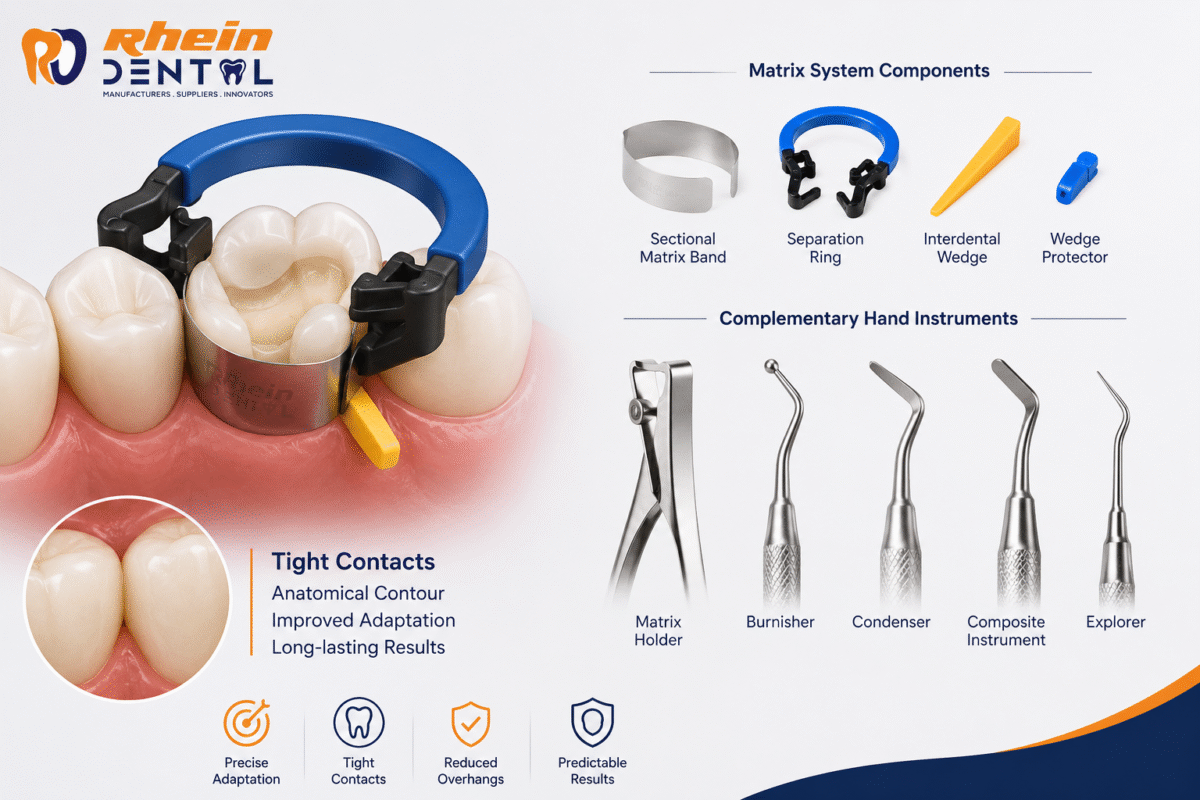
Creating tight and anatomically accurate contact points is one of the biggest challenges in Class II restorations. Poor proximal contacts can lead to food impaction, patient discomfort, gingival irritation, and restoration failure. To achieve predictable results, dentists rely on interproximal matrix systems along with complementary hand instruments that assist in contouring, adaptation, and stabilization during restorative procedures.
Modern matrix systems have greatly improved restorative precision, especially in posterior composite restorations where natural proximal anatomy is essential.
What Are Interproximal Matrix Systems?
Interproximal matrix systems are devices used to temporarily replace the missing wall of a tooth during restorative procedures. They help shape restorative materials while maintaining proper contour and contact with adjacent teeth.
These systems typically include:
- Matrix bands
- Separation rings
- Wedges
- Retainers or stabilizers
Their main purpose is to recreate natural tooth anatomy and establish tight contact points.
Importance of Tight Contact Points
Proper proximal contacts are essential for both function and oral health.
Benefits Include:
- Prevention of food impaction
- Improved periodontal health
- Better occlusal stability
- Enhanced patient comfort
- Longer restoration lifespan
Without proper contact formation, restorations may feel uncomfortable and contribute to plaque accumulation around the restored area.
Types of Matrix Systems
Circumferential Matrix Systems
Traditional Tofflemire systems are commonly used in restorative dentistry, particularly for amalgam restorations.
Advantages
- Easy to use
- Good stability
- Suitable for larger restorations
Limitations
- May create flatter proximal contours
- Less effective for tight composite contacts
Sectional Matrix Systems
Sectional matrix systems are widely preferred for posterior composite restorations.
These systems use pre-contoured bands combined with separation rings and wedges to produce natural contact anatomy.
Benefits
- Better contact formation
- Improved emergence profile
- Reduced overhang risk
- More natural tooth contours
Because of their precision, sectional matrices are considered highly effective for modern adhesive dentistry.
Complementary Hand Instruments
Matrix systems work best when paired with supportive hand instruments.
Wedges
Wedges help adapt the matrix band at the gingival margin while creating slight tooth separation.
Functions
- Prevent gingival overhangs
- Stabilize the matrix
- Improve cervical adaptation
Wooden and plastic wedges are both commonly used depending on clinical preference.
Separation Rings
Separation rings provide temporary tooth separation to compensate for matrix band thickness.
Benefits
- Creates tighter contact points
- Stabilizes sectional matrices
- Improves restoration accuracy
Nickel-titanium rings are especially popular due to their flexibility and consistent force.
Burnishers
Burnishers help contour the matrix band against adjacent teeth before restorative material placement.
Advantages
- Enhances proximal contact
- Improves matrix adaptation
- Helps create natural contours
Ball burnishers are frequently used for this purpose.
Composite Placement Instruments
Non-stick composite instruments assist in placing and adapting restorative material without pulling or sticking.
Their Role
- Smooth incremental placement
- Better adaptation to cavity walls
- Reduced void formation
Teflon-coated and titanium instruments are commonly preferred for composite restorations.
Common Challenges in Class II Restorations
Open Contacts
Usually caused by poor matrix adaptation or inadequate tooth separation.
Gingival Overhangs
Often result from improper wedge placement or unstable matrix bands.
Flat Proximal Contours
Can occur when non-contoured matrix systems are used.
Proper instrument selection and technique help minimize these complications.
Conclusion
Interproximal matrix systems are essential for achieving tight and anatomically correct contact points in Class II restorations. However, their success depends heavily on the complementary hand instruments used during the procedure.
Wedges, separation rings, burnishers, and composite placement instruments all contribute to better contouring, adaptation, and restorative precision. By combining modern matrix systems with proper clinical technique, dentists can achieve durable restorations, improved patient comfort, and predictable restorative outcomes.