
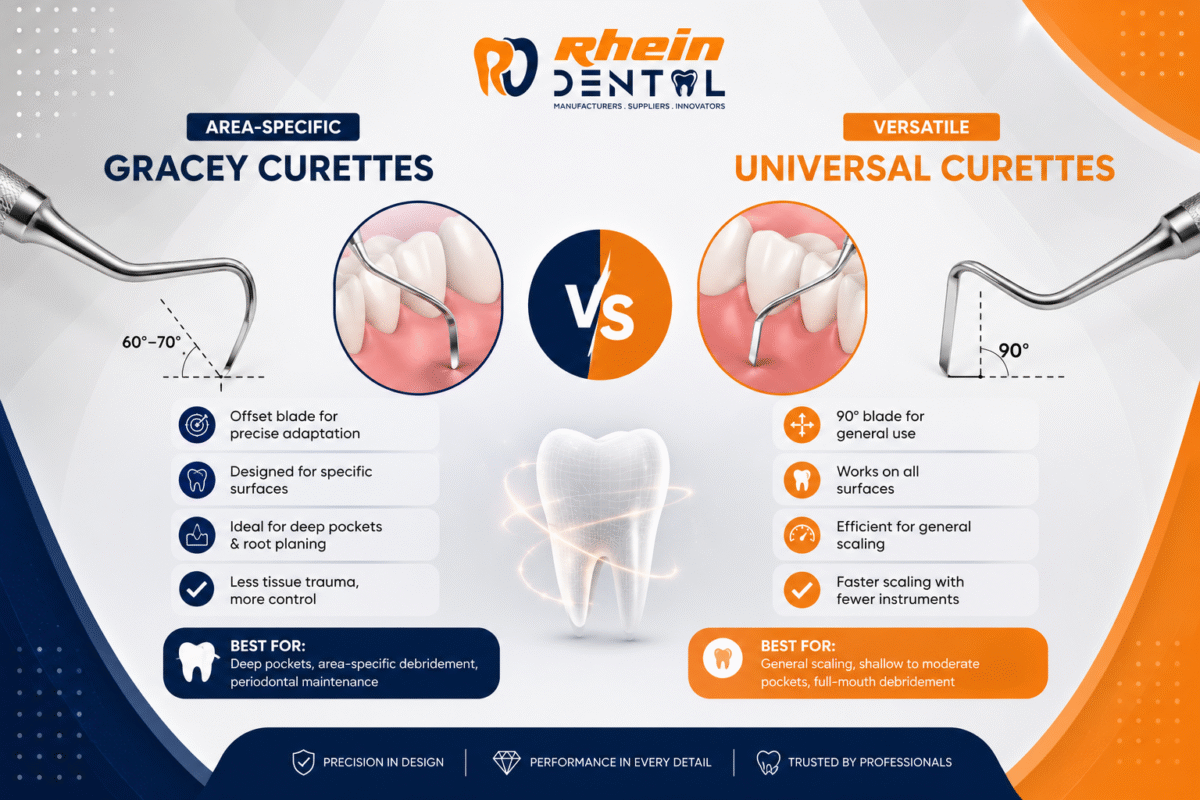
Root surface debridement is one of the most technique-sensitive procedures in periodontal therapy. Achieving a biologically acceptable root surface while preserving healthy tooth structure depends heavily on the correct selection and use of curettes. Among the most widely used periodontal instruments are Gracey curettes and universal curettes—each designed with specific blade angulations and clinical applications in mind.
Understanding when to use each instrument is essential for effective calculus removal, minimal trauma to root surfaces, and improved periodontal healing outcomes.
Understanding Curettes in Periodontal Therapy
Curettes are hand instruments designed for:
- Subgingival calculus removal
- Root surface debridement
- Removal of contaminated cementum
- Smoothing root surfaces
- Periodontal pocket debridement
They are characterized by a rounded toe and a curved blade, making them safer and more adaptable for subgingival use compared to scalers.
What Are Gracey Curettes?
Gracey curettes are area-specific, offset-blade instruments designed for precise subgingival instrumentation in specific tooth regions.
Key Design Features:
- Single cutting edge (lower blade only)
- 70° blade angulation relative to the shank
- Offset blade for adaptation to specific root surfaces
- Area-specific numbering system
Common Gracey Sets and Their Use:
- Gracey 1/2 & 3/4: Anterior teeth (incisors and canines)
- Gracey 5/6: Anterior and premolars
- Gracey 7/8 & 9/10: Buccal and lingual posterior surfaces
- Gracey 11/12: Mesial posterior surfaces
- Gracey 13/14: Distal posterior surfaces
Each instrument is designed to optimize adaptation to a specific anatomical region.
What Are Universal Curettes?
Universal curettes are non-area-specific instruments designed to be used on all tooth surfaces.
Key Design Features:
- Two cutting edges (both blades active)
- Blade set at approximately 90° to the shank
- Symmetrical design for multi-surface use
- Versatile application across the entire dentition
Common Example:
- Columbia 13/14 universal curette
Key Differences: Gracey vs Universal Curettes
1. Blade Angulation
- Gracey Curettes: Offset blade (approx. 70°), allows better subgingival adaptation
- Universal Curettes: Neutral blade (approx. 90°), used for all surfaces
The angulation difference is critical in determining how well the instrument adapts to root anatomy.
2. Cutting Edges
- Gracey Curettes: Single cutting edge (more controlled, selective cutting)
- Universal Curettes: Dual cutting edges (more versatile but less selective)
3. Area Specificity
- Gracey Curettes: Designed for specific tooth regions
- Universal Curettes: Suitable for all areas of the mouth
4. Clinical Precision
- Gracey Curettes: Higher precision in deep pockets and root morphology adaptation
- Universal Curettes: Efficient for general scaling and moderate deposits
5. Instrument Handling
- Gracey Curettes: Requires correct adaptation technique (slight rotation and angulation control)
- Universal Curettes: Easier learning curve, more straightforward use
When to Choose Gracey Curettes
Gracey curettes are preferred when precision and anatomical adaptation are critical.
Ideal Clinical Situations:
- Deep periodontal pockets (>4 mm)
- Root surface debridement in complex anatomy
- Furcation involvement cases
- Minimal tissue trauma required
- Final refinement after scaling
Advantages:
- Superior root adaptation
- Less tissue damage
- More efficient subgingival access
- Better access in posterior and interproximal areas
When to Choose Universal Curettes
Universal curettes are ideal for general periodontal instrumentation and efficiency-focused procedures.
Ideal Clinical Situations:
- Routine scaling and debridement
- Maintenance therapy
- Patients with mild to moderate calculus
- Full-mouth scaling procedures
- Limited instrument setups
Advantages:
- One instrument for all surfaces
- Reduced instrument switching
- Cost-effective
- Easy to learn and use
Role of Blade Angulation in Clinical Performance
Blade angulation directly influences:
- Access to subgingival areas
- Efficiency of calculus removal
- Adaptation to root concavities
- Operator ergonomics
Gracey Curettes:
The offset 70° angulation allows the cutting edge to remain closely adapted to root surfaces, especially in deep pockets and concavities.
Universal Curettes:
The 90° angulation provides balanced access but may require more adaptation changes during use.
Root Surface Debridement: Why Instrument Choice Matters
Effective root surface debridement is not just about removing calculus—it is about preparing a biologically compatible surface for periodontal healing.
Incorrect instrument selection can lead to:
- Incomplete calculus removal
- Excessive cementum removal
- Root surface damage
- Increased post-operative sensitivity
- Delayed healing
Choosing between Gracey and universal curettes ensures predictable and controlled outcomes.
Clinical Technique Considerations
Gracey Curette Technique:
- Use light lateral pressure
- Maintain correct insertion angle
- Employ short, controlled strokes
- Adapt blade to specific tooth surface
Universal Curette Technique:
- Use alternating cutting edges
- Maintain stable fulcrum
- Apply consistent strokes across surfaces
- Adjust angulation frequently for adaptation
Efficiency vs Precision: Clinical Balance
| Feature | Gracey Curettes | Universal Curettes |
|---|---|---|
| Precision | High | Moderate |
| Efficiency | Moderate | High |
| Learning Curve | Steeper | Easier |
| Best Use | Deep, complex cases | Routine scaling |
Clinicians often use both systems together for optimal periodontal outcomes.
Modern Periodontal Practice Approach
In contemporary periodontal therapy, a hybrid instrumentation strategy is commonly used:
- Universal curettes for initial debridement
- Gracey curettes for detailed root refinement
- Ultrasonic scalers for bulk calculus removal
This combination ensures efficiency without compromising precision.
Conclusion
Gracey and universal curettes are both essential tools in periodontal instrumentation, but their effectiveness depends on correct clinical selection. Gracey curettes, with their area-specific design and precise blade angulation, excel in deep and anatomically complex cases. Universal curettes, on the other hand, provide versatility and efficiency for routine periodontal therapy.
A skilled clinician understands not only how to use these instruments but also when to select each one for optimal root surface debridement. Mastery of both ensures improved periodontal health, better healing outcomes, and long-term stability of dental structures.