
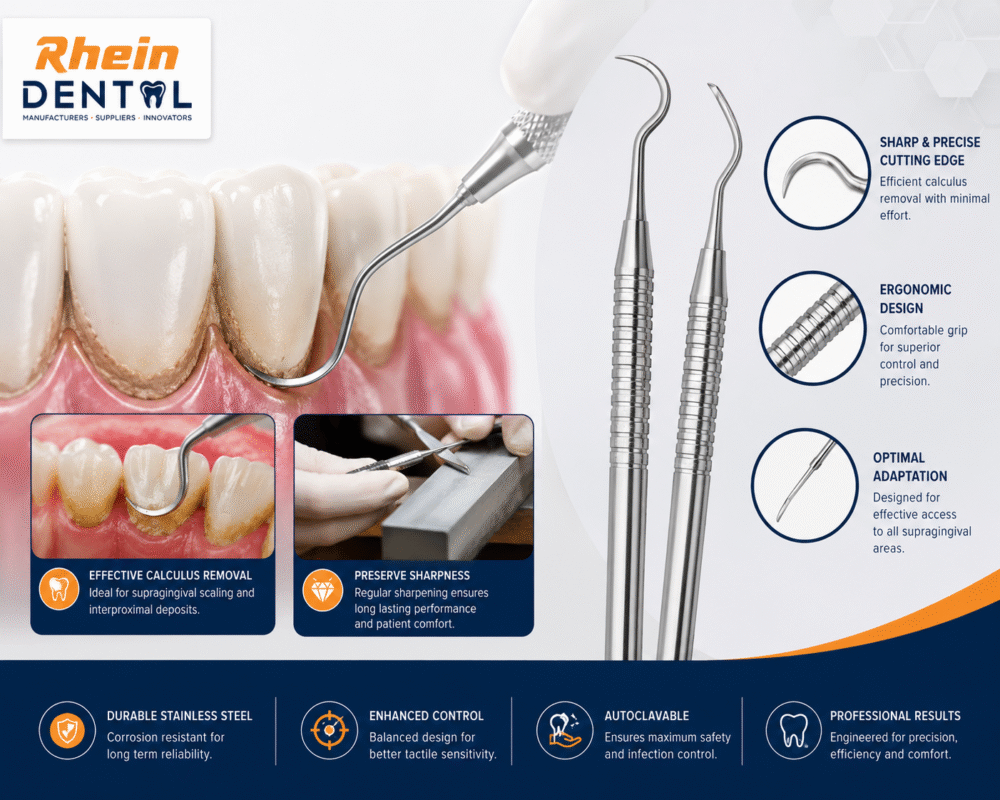
Dental hand instrumentation remains one of the most essential skills in preventive and periodontal therapy. Among the wide range of periodontal instruments available today, sickle scalers and Jacquette instruments continue to play a critical role in the efficient removal of supragingival calculus. Their sharp pointed tips, triangular cross-sections, and dual cutting edges make them highly effective for disrupting tenacious deposits above the gingival margin.
However, successful clinical outcomes depend not only on selecting the correct scaler but also on understanding proper adaptation, stroke control, angulation, and cutting edge preservation. Improper use can quickly dull the instrument, damage enamel, or traumatize gingival tissues. Mastering these techniques helps clinicians improve efficiency while maintaining patient comfort and instrument longevity.
Understanding Sickle Scalers and Jacquette Instruments
Sickle scalers are designed primarily for supragingival calculus removal. They feature:
- A triangular cross-section
- Two cutting edges
- A pointed tip
- Straight or curved working ends
Jacquette instruments are essentially straight-bladed sickle scalers commonly used for anterior teeth and interproximal areas. Posterior Jacquette designs incorporate contra-angled shanks for improved access around molars and premolars.
Because of their pointed design, these instruments are highly effective for engaging heavy supragingival deposits. Their rigid structure allows clinicians to apply firm pull strokes that fracture and lift calculus away from the tooth surface.
Clinical Indications for Sickle Scalers
Sickle scalers and Jacquette instruments are most effective in:
- Heavy supragingival calculus removal
- Interproximal calculus deposits
- Anterior supragingival scaling
- Gross debridement before fine root instrumentation
- Orthodontic and lingual retainer cleaning
They are especially useful during initial debridement when bulky calculus must be removed quickly before transitioning to curettes or ultrasonic instruments for detailed subgingival therapy.
Areas Where Sickle Scalers Should Be Used Carefully
Although highly efficient, sickle scalers are not ideal for deep subgingival instrumentation because their pointed tips can traumatize soft tissues and gouge root surfaces. Several periodontal references emphasize that curettes are safer for root planing and deep pocket instrumentation.
Clinicians should avoid excessive subgingival insertion unless using thinner, specially designed sickle instruments for shallow deposits near the gingival margin.
Proper Instrument Grasp and Fulcrum
Effective calculus removal begins with correct ergonomics and instrument stabilization.
Modified Pen Grasp
The modified pen grasp provides:
- Maximum tactile sensitivity
- Controlled pressure
- Reduced operator fatigue
- Improved precision during scaling
The thumb, index finger, and middle finger control the handle while the ring finger acts as the fulcrum.
Stable Fulcrum
A firm intraoral fulcrum improves:
- Stroke stability
- Adaptation accuracy
- Force control
- Patient comfort
Without a secure fulcrum, excessive lateral pressure may damage tooth surfaces or dull the instrument prematurely.
Blade Adaptation and Angulation
Correct adaptation is essential for effective scaling and cutting edge preservation.
Ideal Working Angulation
Clinical recommendations suggest maintaining a blade-to-tooth angle between 70° and 80° during active scaling strokes.
Angles below this range may burnish calculus rather than remove it, while excessive angulation increases the risk of tissue trauma and edge wear.
Terminal Third Adaptation
Only the terminal third of the cutting edge should contact the tooth surface. This improves precision and reduces unnecessary friction against enamel or cementum.
Scaling Stroke Techniques
Vertical Pull Strokes
Vertical strokes are commonly used on:
- Mesial and distal surfaces
- Anterior teeth
- Narrow interproximal spaces
These strokes effectively engage and fracture supragingival calculus.
Oblique Strokes
Oblique strokes improve access on:
- Posterior teeth
- Line angles
- Broad tooth surfaces
They help maintain blade adaptation around curved anatomy.
Horizontal Strokes
Horizontal strokes are useful for:
- Tight interproximal contacts
- Line angles
- Stubborn ledges of calculus
These strokes should be controlled carefully to avoid soft tissue injury.
Jacquette Instrument Applications
Jacquette scalers are especially valued for:
- Precise anterior scaling
- Fine interproximal adaptation
- Tight contact access
- Rapid supragingival deposit removal
Their straight design offers excellent visibility and tactile feedback during anterior instrumentation.
Posterior Jacquette variations with contra-angle shanks improve adaptation in molar regions where direct access is more difficult.
Common Clinical Errors
Excessive Pressure
Applying too much lateral pressure can:
- Scratch enamel
- Cause operator fatigue
- Accelerate cutting edge dullness
- Increase patient discomfort
Incorrect Angulation
Improper angulation may:
- Burnish calculus
- Lacerate gingiva
- Reduce scaling efficiency
- Damage root surfaces
Poor Adaptation
Failure to maintain terminal third adaptation can create:
- Root gouging
- Tissue trauma
- Incomplete calculus removal
Preserving the Cutting Edge
Instrument sharpness directly affects scaling efficiency. Sharp instruments remove deposits more easily with less pressure and less trauma to the patient.
Why Cutting Edge Preservation Matters
A properly maintained cutting edge:
- Enhances tactile sensitivity
- Improves calculus engagement
- Reduces clinician fatigue
- Minimizes repetitive strokes
- Improves patient comfort
Best Practices for Edge Preservation
Use Correct Angulation
Avoid excessive opening of the blade angle during instrumentation.
Employ Short Controlled Strokes
Short 2–3 mm strokes improve control and reduce unnecessary edge wear.
Avoid Excessive Lateral Pressure
Heavy pressure dulls the blade more rapidly and increases hand fatigue.
Proper Sharpening Technique
Sharpen instruments regularly using:
- Arkansas stones
- Ceramic stones
- Diamond sharpening systems
Maintaining the original blade design is critical during sharpening to preserve effectiveness.
Inspect Instruments Frequently
Clinicians should routinely check for:
- Rounded edges
- Light reflection along the blade
- Reduced tactile engagement
- Skipping or sliding during scaling
Instrument Sequencing in Clinical Practice
Many clinicians combine sickle scalers with curettes and ultrasonic instruments for comprehensive debridement. A common sequence includes:
- Initial gross supragingival scaling with sickle scalers
- Ultrasonic instrumentation for biofilm disruption
- Curette finishing strokes for root smoothing
- Exploratory assessment for residual deposits
This workflow increases efficiency while preserving tooth structure and minimizing tissue trauma.
Infection Control and Instrument Maintenance
Proper sterilization and handling are essential for maintaining scaler performance.
Recommended practices include:
- Ultrasonic cleaning before sterilization
- Drying instruments completely before storage
- Protecting cutting edges with instrument cassettes
- Avoiding instrument stacking that damages tips
Routine maintenance significantly extends instrument lifespan and preserves clinical precision.
Conclusion
Sickle scalers and Jacquette instruments remain indispensable tools for supragingival calculus removal. Their sharp pointed design and dual cutting edges provide excellent efficiency for removing heavy deposits, especially in anterior and interproximal regions. When used with proper angulation, adaptation, and controlled strokes, these instruments offer outstanding clinical results while minimizing tissue trauma.
Equally important is preserving the cutting edge through proper sharpening, controlled instrumentation pressure, and routine maintenance. Clinicians who master these principles improve treatment efficiency, patient comfort, and long-term instrument performance.
As periodontal therapy continues to evolve, the fundamental principles of precise hand instrumentation remain central to successful preventive and periodontal care.