
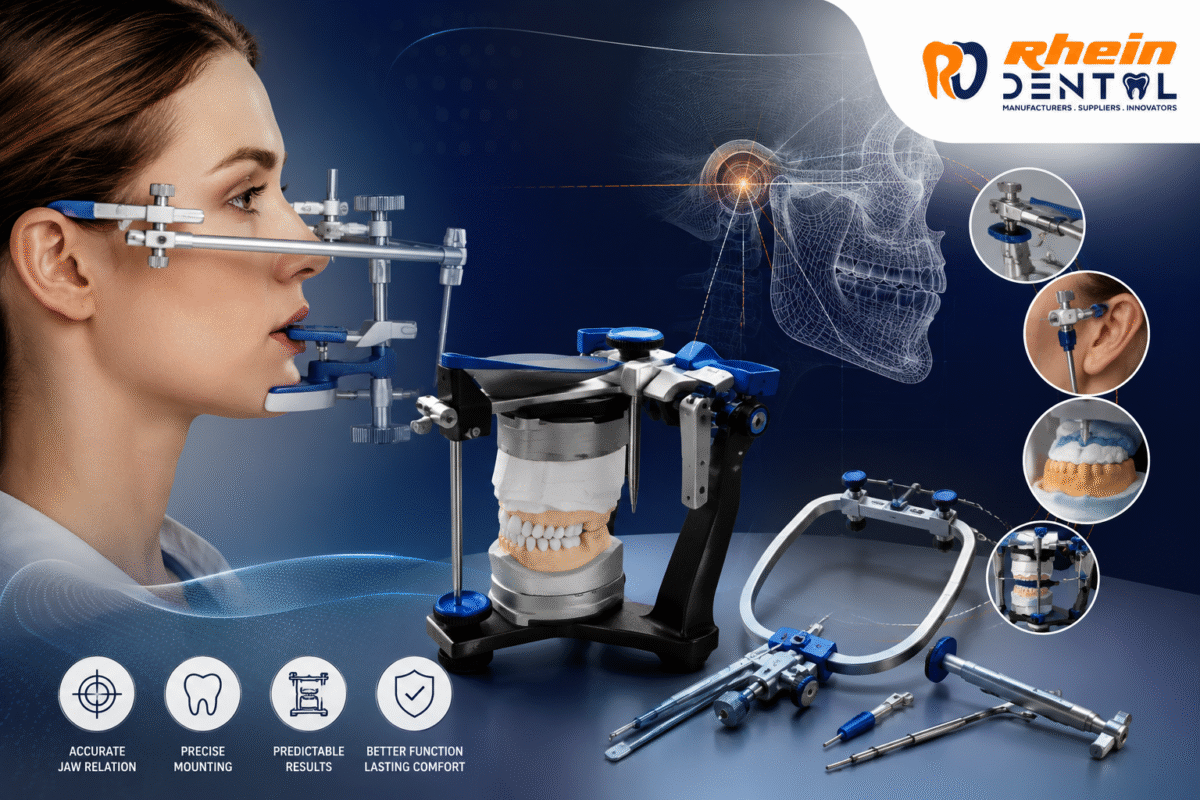
Modern prosthetic dentistry relies heavily on precision. Whether fabricating crowns, bridges, complete dentures, or implant-supported restorations, accurate replication of mandibular movements is essential for long-term function and patient comfort. Among the most critical procedures in prosthodontics are articulator mounting and facebow transfer, which help clinicians establish correct condylar axis relationships and reproduce the patient’s jaw movements outside the oral cavity.
Without proper mounting techniques and accurate facebow transfer records, restorations may suffer from occlusal discrepancies, premature contacts, instability, or patient discomfort. This article explores the role of articulators and facebow transfer instruments in prosthetic dentistry, their clinical importance, types, workflow, and how they contribute to predictable restorative outcomes.
Understanding the Role of Articulators in Prosthetic Dentistry
An articulator is a mechanical device designed to simulate mandibular movements and spatial relationships between the maxilla and mandible. It serves as an extraoral substitute for the temporomandibular joints (TMJs) and associated jaw functions.
Articulators enable clinicians and dental technicians to:
- Analyze occlusion outside the patient’s mouth
- Design restorations with proper functional anatomy
- Reduce chairside adjustment time
- Evaluate dynamic mandibular movements
- Improve accuracy in prosthetic fabrication
When mounted correctly, dental casts on an articulator replicate the patient’s jaw position and movement patterns, allowing restorations to function harmoniously within the stomatognathic system.
What Is a Facebow Transfer?
A facebow transfer is a procedure used to record the spatial relationship of the maxillary arch to the temporomandibular joint axis and transfer this relationship to an articulator.
The facebow captures the orientation of the maxilla relative to the hinge axis, ensuring that mounted casts accurately reflect the patient’s anatomical relationships.
This transfer is particularly important in:
- Full mouth rehabilitation
- Complete denture fabrication
- Complex crown and bridge cases
- Implant prosthodontics
- Occlusal rehabilitation procedures
Without a facebow transfer, restorations may be fabricated on inaccurately positioned casts, leading to occlusal errors and compromised function.
Importance of Correct Condylar Axis Relationships
The condylar axis refers to the rotational center of mandibular movement at the TMJs. Proper reproduction of this axis is critical because mandibular movements directly influence occlusal contacts and prosthetic function.
Incorrect condylar relationships can result in:
- Occlusal interferences
- Uneven force distribution
- Muscle fatigue
- TMJ discomfort
- Premature prosthetic wear
- Repeated adjustments
Accurate facebow transfer and articulator mounting minimize these issues by aligning prosthetic restorations with the patient’s true mandibular dynamics.
Types of Dental Articulators
Dental articulators vary in complexity and capability. Selection depends on the clinical requirements of the case.
1. Simple Hinge Articulators
These basic articulators only allow opening and closing movements.
Characteristics:
- Economical
- Limited movement simulation
- Suitable for simple restorations
Limitations:
- Cannot reproduce lateral or protrusive movements
- Limited accuracy for complex prosthetics
2. Mean Value Articulators
Mean value articulators simulate average mandibular movements based on standard anatomical values.
Advantages:
- More functional than hinge articulators
- Useful for routine prosthodontic procedures
Limitations:
- Do not account for individual patient variations
3. Semi-Adjustable Articulators
Semi-adjustable articulators are among the most commonly used systems in modern dentistry.
Features:
- Adjustable condylar guidance
- Accept facebow transfers
- Simulate lateral and protrusive movements
Clinical Benefits:
- Improved occlusal accuracy
- Better prosthetic adaptation
- Reduced intraoral adjustments
These articulators provide an excellent balance between practicality and precision.
4. Fully Adjustable Articulators
Fully adjustable articulators replicate individualized mandibular movements with high precision.
Applications:
- Extensive rehabilitations
- Advanced prosthodontic cases
- TMJ analysis
Advantages:
- Maximum accuracy
- Custom condylar pathway settings
Drawbacks:
- Higher cost
- Technique sensitive
- Time intensive
Components of a Facebow System
A facebow instrument typically consists of several essential components:
U-Shaped Frame
The main framework extending from the patient’s face to the articulator.
Bite Fork
Records the maxillary arch relationship.
Condylar Rods or Ear Pieces
Position the facebow relative to the hinge axis.
Locking Mechanisms
Stabilize the recorded relationship during transfer.
Infraorbital Pointer
Helps establish a third reference point for accurate orientation.
Together, these components ensure consistent and reproducible transfer of maxillary positioning.
Types of Facebows
Kinematic Facebow
A kinematic facebow identifies the patient’s true hinge axis.
Benefits:
- Extremely accurate
- Ideal for complex rehabilitations
Limitations:
- Technique sensitive
- Time consuming
Arbitrary Facebow
An arbitrary facebow estimates the hinge axis using anatomical landmarks.
Advantages:
- Faster and simpler
- Clinically efficient
- Widely used in daily practice
Most prosthodontic procedures are successfully completed using arbitrary facebow systems.
Clinical Procedure for Facebow Transfer
Accurate facebow transfer requires careful attention to detail.
Step 1: Prepare the Bite Fork
The bite fork is coated with recording material and positioned against the maxillary teeth.
Step 2: Stabilize the Facebow
The facebow frame is aligned with anatomical reference points.
Step 3: Record Spatial Relationship
The relationship between the maxilla and hinge axis is captured.
Step 4: Secure the Components
All locking mechanisms are tightened to preserve the record.
Step 5: Transfer to the Articulator
The recorded relationship is transferred to the articulator for cast mounting.
Precision during each step directly affects prosthetic accuracy.
Articulator Mounting Procedures
After obtaining the facebow record, casts are mounted onto the articulator.
Maxillary Cast Mounting
The upper cast is mounted first using the facebow transfer.
Mandibular Cast Mounting
The lower cast is mounted using interocclusal records.
Common Materials Used:
- Mounting stone
- Plaster
- Silicone bite registrations
Proper mounting ensures accurate simulation of jaw movements during prosthetic fabrication.
Applications in Prosthetic Dentistry
Complete Dentures
Accurate articulator mounting helps establish balanced occlusion and denture stability.
Crown and Bridge Work
Proper occlusion minimizes high spots and occlusal adjustments.
Implant Prosthetics
Implant restorations require precise force distribution due to the absence of periodontal ligament cushioning.
Full Mouth Rehabilitation
Complex rehabilitations demand accurate replication of mandibular function for long-term success.
Advantages of Accurate Facebow Transfer and Mounting
Improved Occlusal Precision
Restorations fit more accurately with fewer interferences.
Reduced Chairside Adjustments
Less intraoral correction saves clinical time.
Enhanced Patient Comfort
Proper occlusion reduces muscle strain and TMJ stress.
Better Prosthesis Longevity
Balanced occlusal forces reduce wear and restoration failure.
Increased Laboratory Efficiency
Technicians can fabricate restorations more predictably.
Common Errors in Facebow Transfer
Even small inaccuracies can compromise prosthetic outcomes.
Improper Bite Fork Positioning
May distort maxillary orientation.
Loose Locking Mechanisms
Can alter transfer accuracy during movement.
Incorrect Reference Point Selection
Affects cast orientation on the articulator.
Distorted Interocclusal Records
Leads to mounting inaccuracies.
Proper training and meticulous technique are essential to avoid these issues.
Digital Advancements in Articulator Systems
Digital dentistry is transforming articulator workflows.
Virtual Articulators
Integrated into CAD/CAM software for digital prosthetic design.
Digital Facebow Systems
Use scanners and jaw tracking technologies for enhanced precision.
Advantages of Digital Integration
- Improved workflow efficiency
- Enhanced reproducibility
- Reduced manual errors
- Better communication with laboratories
Despite technological advances, understanding conventional articulator principles remains fundamental for every prosthodontic clinician.
Maintenance and Care of Articulators and Facebows
Regular maintenance preserves accuracy and instrument longevity.
Recommended Practices:
- Clean after each use
- Inspect moving parts regularly
- Calibrate articulators periodically
- Store instruments carefully
- Replace worn components promptly
Well-maintained instruments ensure consistent clinical performance.
Conclusion
Articulator mounting and facebow transfer instruments play a foundational role in modern prosthetic dentistry. By accurately establishing condylar axis relationships and reproducing mandibular movements, these systems help clinicians create restorations that are functional, comfortable, and durable.
From complete dentures to complex implant rehabilitations, proper use of articulators and facebows minimizes occlusal errors, reduces chairside adjustments, and improves patient satisfaction. As digital technologies continue to evolve, the principles of accurate jaw relation recording remain central to successful prosthodontic treatment.
For dental professionals committed to precision and long-term restorative success, mastering articulator mounting and facebow transfer techniques is not optional—it is essential.