
Amalgam carriers remain an essential instrument in restorative dentistry, especially during procedures requiring efficient transfer of amalgam material into cavity preparations. While the instrument may appear simple, its design significantly influences clinical performance. Two critical factors—bore size and spring tension—directly affect the speed, control, and volume of material delivery (Amalgam Carrier Bore Size).
Understanding how these design elements work helps clinicians improve workflow efficiency, minimize material waste, and achieve more consistent restorations.
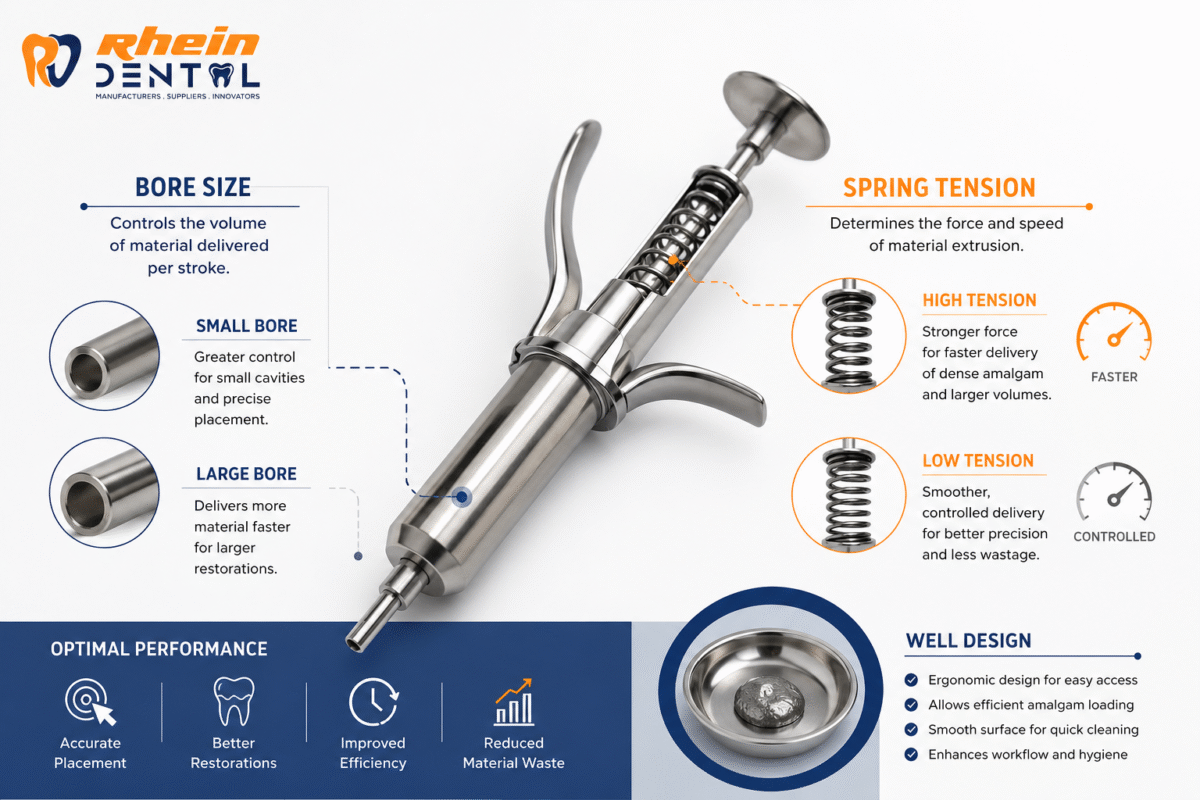
What Is an Amalgam Carrier?
An amalgam carrier is a handheld dental instrument used to transport mixed amalgam from the mixing well directly into the prepared cavity. The instrument typically consists of:
- A hollow cylindrical barrel or bore
- A spring-loaded plunger mechanism
- A dispensing tip
- Finger-grip handles for controlled operation
The carrier allows dentists to place amalgam precisely while maintaining speed and reducing contamination during restorative procedures.
Why Instrument Design Matters
During amalgam placement, timing is critical. Amalgam begins setting shortly after mixing, meaning delayed or inconsistent delivery can affect condensation quality and adaptation.
A poorly designed carrier may cause:
- Slow material dispensing
- Inconsistent increments
- Material sticking inside the bore
- Operator fatigue
- Voids within the restoration
For this reason, clinicians carefully evaluate bore size and spring tension when selecting an amalgam carrier.
Understanding Bore Size in Amalgam Carriers
What Is Bore Size?
The bore refers to the internal diameter of the carrier barrel that holds and transports the amalgam material.
Different carriers are manufactured with varying bore diameters to accommodate different restorative situations.
Small Bore Amalgam Carriers
Small bore carriers are designed for precise placement in smaller cavity preparations.
Advantages
Improved Precision
A smaller opening allows better control when placing amalgam into conservative preparations or difficult-to-access posterior areas.
Reduced Overfilling
Operators can deliver smaller increments, reducing excess material and improving adaptation.
Better Visibility
Smaller carriers can improve access and visibility in tight operative fields.
Limitations
- Requires multiple loading cycles
- Slower delivery in larger restorations
- Increased procedure time
Large Bore Amalgam Carriers
Large bore carriers hold greater volumes of amalgam and are commonly used for extensive restorations.
Advantages
Faster Material Delivery
Larger bores transport more amalgam per increment, improving procedural efficiency.
Reduced Reloading
Fewer loading cycles help shorten chair time.
Efficient for Multi-Surface Restorations
Useful when restoring larger cavities requiring significant amalgam volume.
Limitations
- Reduced precision in small cavities
- Potential for overpacking
- Greater risk of material extrusion
How Bore Size Affects Delivery Speed
Delivery speed depends largely on how much amalgam can move through the barrel during each activation.
Larger Bore = Faster Delivery
A wider internal diameter allows more amalgam to pass through with each compression of the plunger mechanism.
This improves efficiency during:
- Large Class II restorations
- Deep posterior cavities
- Multi-surface restorations
Smaller Bore = Controlled Delivery
Smaller bores slow the flow rate intentionally, allowing:
- Incremental placement
- Better adaptation
- Improved operator control
Clinicians often choose bore size based on restoration complexity rather than using a single universal carrier.
Understanding Spring Tension in Amalgam Carriers
What Is Spring Tension?
Spring tension refers to the resistance generated by the internal spring mechanism that pushes the amalgam through the carrier tip.
The spring controls:
- Force of material extrusion
- Smoothness of operation
- Speed of dispensing
- Operator comfort
High Spring Tension
High-tension carriers require greater hand pressure to activate.
Benefits
Stronger Material Projection
Provides forceful extrusion for dense amalgam mixes.
Faster Increment Release
Helps quickly place amalgam into deeper preparations.
Improved Compaction Assistance
May aid in tightly packing amalgam before condensation.
Drawbacks
- Increased hand fatigue
- Less tactile sensitivity
- Risk of excessive extrusion
Low Spring Tension
Low-tension mechanisms require less pressure during activation.
Benefits
Better Control
Allows smoother and more gradual dispensing.
Reduced Operator Fatigue
Comfortable during long restorative sessions.
Improved Precision
Useful in delicate or conservative preparations.
Drawbacks
- Slower extrusion speed
- May struggle with dense amalgam mixtures
- Potential incomplete dispensing
Relationship Between Bore Size and Spring Tension
The most effective amalgam carriers balance both design factors together.
For example:
| Bore Size | Spring Tension | Clinical Effect |
|---|---|---|
| Small Bore | Low Tension | Maximum precision and control |
| Small Bore | High Tension | Rapid delivery in confined areas |
| Large Bore | Low Tension | Smooth bulk placement |
| Large Bore | High Tension | Fast high-volume dispensing |
Manufacturers carefully calibrate these features to optimize ergonomics and restorative efficiency.
Clinical Applications
Pediatric Restorations
Small bore carriers with moderate spring tension provide better control for conservative cavity preparations in children.
Posterior Multi-Surface Restorations
Large bore carriers improve speed and reduce repeated loading during extensive restorations.
Deep Proximal Cavities
Balanced spring tension helps deliver amalgam effectively into difficult-to-access areas without excessive force.
Ergonomics and Operator Comfort
Instrument ergonomics directly affect clinician performance.
Poorly calibrated spring tension can lead to:
- Finger strain
- Hand fatigue
- Reduced tactile control
- Slower restorative procedures
Modern amalgam carriers are increasingly designed with:
- Lightweight stainless steel construction
- Smooth plunger action
- Ergonomic grips
- Precision-engineered springs
These improvements enhance comfort while maintaining consistent material delivery.
Maintenance and Performance Consistency
Even high-quality amalgam carriers lose efficiency without proper maintenance.
Important Maintenance Practices
Regular Cleaning
Residual amalgam inside the bore can obstruct material flow.
Spring Inspection
Weak or damaged springs reduce delivery consistency.
Sterilization Compliance
Proper sterilization prevents corrosion and preserves mechanical function.
Lubrication
Some reusable carriers require periodic lubrication for smooth plunger movement.
Routine maintenance ensures predictable performance and extends instrument lifespan.
Choosing the Right Amalgam Carrier
When selecting an amalgam carrier, clinicians should evaluate:
- Type of restorative procedures performed
- Preferred amalgam consistency
- Desired delivery speed
- Hand comfort and ergonomics
- Accessibility requirements
- Instrument durability
Many practitioners keep multiple bore sizes available to accommodate different clinical situations.
Conclusion
Amalgam carriers play a much larger role in restorative success than many clinicians realize. Bore size determines the volume and speed of material delivery, while spring tension influences extrusion force, control, and operator comfort.
Smaller bores provide precision and incremental placement, whereas larger bores improve efficiency during extensive restorations. Similarly, spring tension must balance dispensing power with ergonomic comfort.
By understanding these design characteristics, dental professionals can select the most suitable amalgam carrier for each procedure, improving workflow efficiency, restoration quality, and overall clinical performance.