
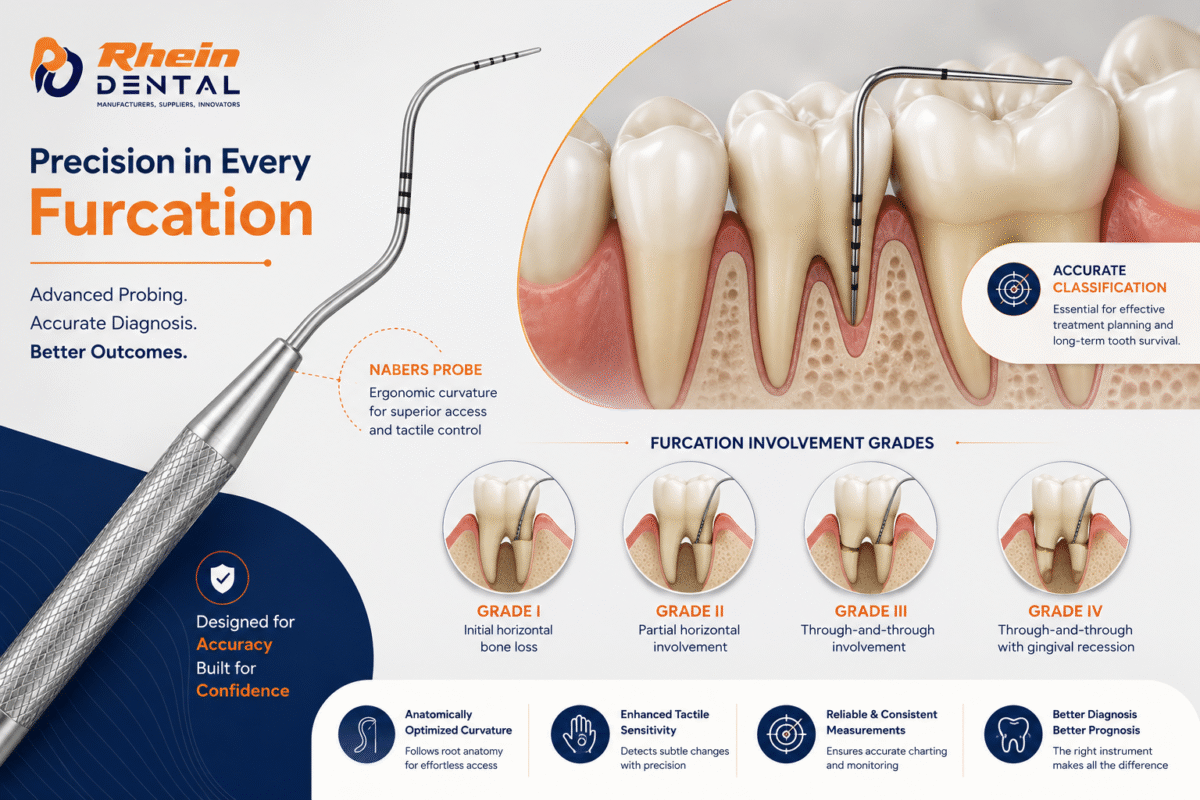
Accurate periodontal diagnosis is essential for successful treatment planning, especially when dealing with complex anatomical regions such as molar furcations. Furcation involvement is one of the most challenging aspects of periodontal disease because it affects the area between the roots of multi-rooted teeth, making cleaning, maintenance, and treatment significantly more difficult. To evaluate these areas properly, clinicians rely on specialized diagnostic instruments known as furcation probes, with the Nabers probe being the most widely used.
The unique curved design of the Nabers probe allows dental professionals to assess furcation involvement with greater precision and reliability. Understanding the curvature of the probe, the grading systems used for classification, and proper probing techniques is critical for achieving accurate periodontal diagnosis and improving long-term patient outcomes.
Understanding Furcation Involvement
Furcation involvement occurs when periodontal bone loss extends into the interradicular space of multi-rooted teeth, typically molars. These defects develop as periodontal disease progresses and destroys the supporting bone around the roots.
Molars are especially vulnerable because of their complex root anatomy and difficult-to-clean furcation areas. Once the furcation becomes involved, plaque accumulation increases, oral hygiene becomes more challenging, and the risk of tooth loss rises considerably.
Early detection is therefore essential for preserving tooth stability and planning effective periodontal therapy.
What Is a Nabers Furcation Probe?
A Nabers furcation probe is a specialized periodontal instrument specifically designed to evaluate furcation involvement in multi-rooted teeth. Unlike traditional straight periodontal probes, the Nabers probe features a curved working end that allows easier access into furcation entrances.
The curved design helps clinicians navigate around root contours while maintaining close adaptation to the tooth surface. The instrument is typically marked with measurement indicators that help determine the horizontal depth of furcation penetration.
Because furcation defects often develop beneath the gingival tissues and are difficult to visualize directly, the Nabers probe plays a vital role in detecting and classifying periodontal destruction accurately.
Importance of Probe Curvature in Furcation Diagnosis
The defining characteristic of the Nabers probe is its curved working end. This curvature is essential because furcation entrances are rarely accessible with straight instruments.
The curved design offers several clinical advantages:
- Improved access to furcation entrances
- Better adaptation to root anatomy
- Enhanced tactile sensitivity
- More accurate horizontal probing
- Reduced risk of false-negative readings
Different furcation locations may require slightly different insertion angles depending on whether the tooth is maxillary or mandibular. Proper use of the curved probe allows clinicians to explore furcation defects gently and effectively without causing unnecessary tissue trauma.
Nabers Probe Curvature Designs and Their Clinical Use
Standard Curvature Design
The standard Nabers probe curvature is suitable for most routine periodontal examinations. It provides balanced flexibility and access for evaluating mandibular molar furcations and selected maxillary furcation areas.
This design is commonly used during:
- General periodontal assessments
- Routine furcation screening
- Maintenance evaluations
- Initial periodontal charting
The moderate curve helps clinicians maintain excellent tactile control while assessing horizontal attachment loss.
Advanced Curvature for Complex Furcations
Maxillary molars present additional challenges because they contain three furcation entrances instead of two. Specialized Nabers probes may incorporate deeper or more pronounced curvatures to improve access to:
- Mesial furcations
- Distal furcations
- Palatal furcation areas
These enhanced curves allow clinicians to navigate difficult anatomical regions more effectively and improve diagnostic accuracy.
Correct Technique for Furcation Probing
Using the Nabers probe correctly is just as important as selecting the proper instrument design. Accurate diagnosis depends heavily on probing technique and tactile interpretation.
Recommended Clinical Technique
- Insert the probe gently beneath the gingival margin.
- Keep the curved working end adapted against the root surface.
- Advance the probe horizontally into the furcation entrance.
- Use light exploratory movements to detect bone loss.
- Evaluate the depth and extent of horizontal penetration.
- Record the furcation grade accurately.
Excessive pressure should always be avoided because it may traumatize tissues and create misleading readings.
Furcation Classification Grades
The severity of furcation involvement is commonly classified using the Glickman grading system. This system helps clinicians determine prognosis and select the most appropriate treatment approach.
Grade I Furcation Involvement
Grade I represents the earliest stage of furcation involvement. Bone loss is minimal, and the probe enters only slightly into the furcation area.
Characteristics include:
- Incipient bone loss
- Mild horizontal penetration
- Minimal radiographic changes
- Favorable treatment prognosis
At this stage, periodontal therapy and improved oral hygiene can often prevent further progression.
Grade II Furcation Involvement
Grade II furcation involvement indicates partial horizontal bone loss. The probe penetrates deeper into the furcation but does not pass completely through the defect.
Clinical features include:
- Moderate attachment loss
- Cul-de-sac furcation defect
- Increased plaque retention
- More complex periodontal maintenance
These lesions may require advanced periodontal treatment and careful long-term monitoring.
Grade III Furcation Involvement
In Grade III involvement, bone destruction becomes severe enough for the probe to pass entirely through the furcation area. However, soft tissues may still partially cover the entrance clinically.
Common characteristics include:
- Through-and-through furcation defect
- Advanced periodontal destruction
- Difficult maintenance access
- Compromised tooth prognosis
Treatment often involves surgical periodontal therapy or regenerative procedures.
Grade IV Furcation Involvement
Grade IV furcation involvement is similar to Grade III, except the furcation is clinically visible because of gingival recession.
These advanced lesions are associated with:
- Severe attachment loss
- Exposed furcation entrances
- Significant root exposure
- Increased risk of tooth mobility
Grade IV defects present major restorative and periodontal challenges and require comprehensive treatment planning.
Challenges in Accurate Furcation Classification
Several factors can complicate furcation assessment and affect diagnostic accuracy.
Anatomical Variations
Differences in root shape, root trunk length, and furcation entrance width can influence probe access and tactile interpretation.
Limited Visibility
Furcation defects are often hidden beneath gingival tissues, making direct visualization difficult.
Presence of Calculus
Subgingival calculus may block probe penetration and create misleading findings during examination.
Tissue Inflammation
Inflamed periodontal tissues can reduce tactile sensitivity and affect probing precision.
For this reason, clinicians often combine clinical probing with radiographic evaluation to achieve a more accurate diagnosis.
Importance of Accurate Furcation Diagnosis
Precise furcation classification is essential because it directly influences:
- Periodontal treatment planning
- Surgical decision-making
- Prognosis evaluation
- Maintenance frequency
- Long-term tooth preservation
Even minor diagnostic inaccuracies can lead to inappropriate treatment strategies or overlooked periodontal progression.
Periodontal Maintenance and Long-Term Monitoring
Patients with furcation involvement require ongoing periodontal maintenance and close monitoring. Furcation areas are difficult for patients to clean effectively, increasing the risk of recurrent periodontal breakdown.
Successful long-term management typically includes:
- Frequent periodontal recall visits
- Professional periodontal maintenance
- Enhanced plaque control techniques
- Specialized interdental cleaning aids
- Continuous reassessment of furcation status
Regular monitoring helps clinicians identify disease progression early and adjust treatment accordingly.
Conclusion
The Nabers furcation probe remains one of the most important diagnostic instruments in periodontology because of its specialized curved design and ability to accurately assess furcation involvement. Its curvature allows clinicians to navigate complex molar anatomy and evaluate horizontal bone loss with improved precision.
From early Grade I lesions to advanced Grade IV defects, accurate classification of furcation involvement plays a critical role in periodontal diagnosis, treatment planning, and long-term tooth survival. Mastering the use of Nabers probes and understanding furcation grading systems are essential skills for every dental professional committed to delivering high-quality periodontal care.