
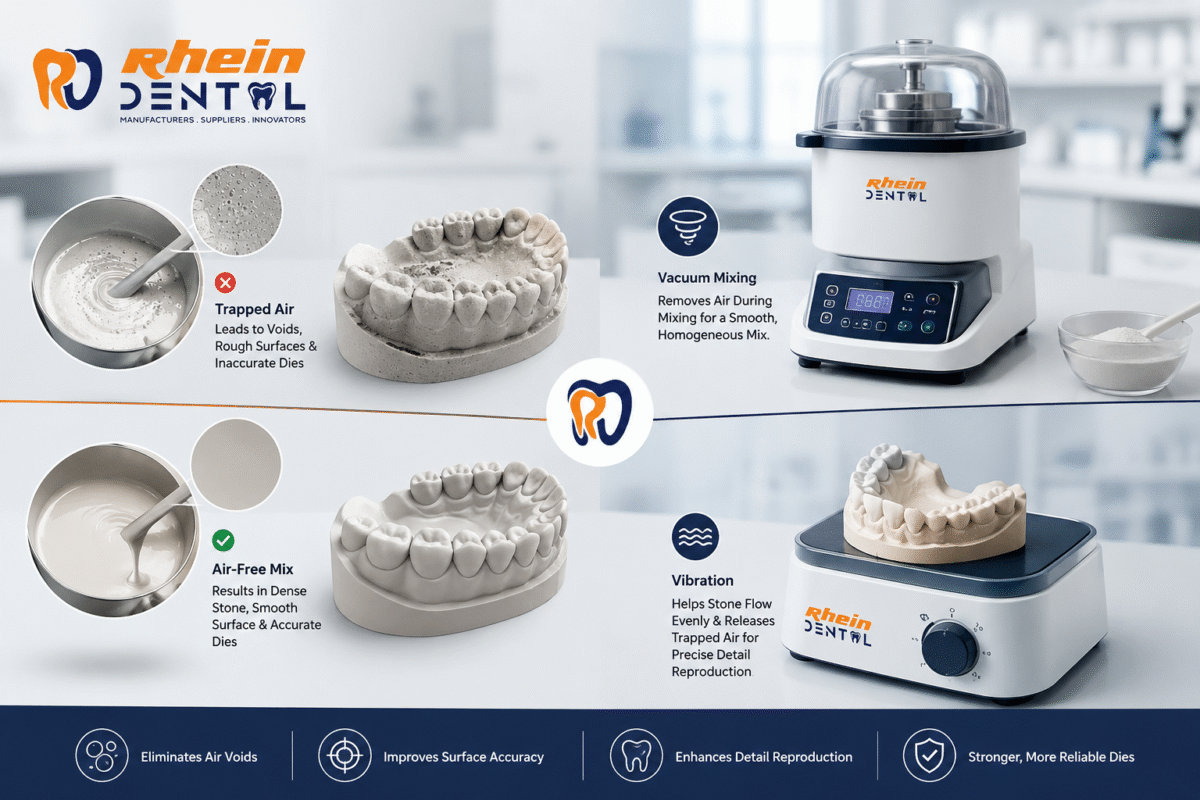
Stone dies are only as accurate as the material and method used to produce them. In dental laboratories, even the smallest air voids in gypsum stone can distort margins, compromise surface detail, and ultimately affect the fit of indirect restorations. That’s where vibrators and vacuum mixers play a critical role. Together, they transform a traditionally manual and error-prone process into a controlled, high-precision workflow that significantly improves die surface accuracy.
Why Air Voids Are a Serious Problem in Stone Mixing
When dental stone is mixed manually or poured without proper technique, air gets trapped within the slurry. These microbubbles may seem insignificant at first, but they create noticeable defects once the stone sets.
Air voids can lead to:
- Rough or pitted die surfaces
- Inaccurate margin reproduction
- Weak points in the cast structure
- Reduced clarity of fine anatomical details
For restorative and prosthetic work, even a minor surface defect can translate into misfit crowns, poor contact points, or compromised occlusion. In short, accuracy at the mixing stage determines accuracy at the final restoration stage.
Vibrators: The First Line of Defense Against Entrapped Air
Dental vibrators are designed to help gypsum flow smoothly into impressions by using controlled mechanical vibration. This vibration reduces surface tension and allows trapped air bubbles to rise to the surface and escape.
How Vibrators Improve Casting Accuracy
When an impression filled with stone is placed on a vibrator:
- The stone flows more evenly into fine details
- Air bubbles are dislodged before setting begins
- Material adapts better to narrow grooves and margins
A properly adjusted vibration setting is key. Too much vibration can cause material separation, while too little fails to eliminate air pockets effectively. Skilled technicians often adjust intensity based on stone type and impression complexity.
Vacuum Mixers: Eliminating Air Before It Even Reaches the Impression
While vibrators address air during pouring, vacuum mixers eliminate air at the mixing stage itself. This is a more proactive and highly effective approach.
A vacuum mixer blends gypsum powder and water under reduced pressure, removing air from the mixture while it is being prepared.
Benefits of Vacuum Mixing
- Produces a denser, smoother stone mix
- Virtually eliminates internal air bubbles
- Improves surface hardness and wear resistance
- Enhances reproduction of fine anatomical detail
- Reduces inconsistencies caused by manual mixing techniques
The result is a homogenous mix that sets more uniformly and produces highly accurate dies with minimal surface defects.
Vibrator vs Vacuum Mixer: Understanding the Difference
Although both tools aim to reduce air voids, they work at different stages:
- Vacuum Mixer: Removes air during mixing (preventive approach)
- Vibrator: Removes air during pouring (corrective approach)
In modern dental laboratories, these tools are not competitors but complements. Using both ensures maximum accuracy from start to finish.
Impact on Die Surface Accuracy and Clinical Outcomes
High-quality die accuracy is essential for fabricating restorations that require precise adaptation, especially in:
When air voids are eliminated:
- Marginal integrity improves
- Adjustments at seating are reduced
- Patient chair time decreases
- Longevity of restorations increases
In essence, better stone mixing directly contributes to better clinical success.
Best Practices for Optimal Results
To achieve consistently accurate dies, dental technicians should follow a disciplined workflow:
- Always measure water and powder accurately
- Use a vacuum mixer for consistent slurry preparation
- Adjust vibration intensity based on case requirements
- Avoid over-vibration to prevent material separation
- Pour stone in a controlled, continuous flow
Attention to these details ensures that the final cast truly represents the original impression without distortion.
Conclusion
Vibrators and vacuum mixers are essential tools in modern dental laboratory workflows, not just for convenience but for precision. By eliminating air voids at both the mixing and pouring stages, they significantly enhance die surface accuracy and ensure better-fitting restorations.
In a field where microns matter, investing in proper mixing technology is not optional—it is fundamental to producing predictable, high-quality dental outcomes.