
In dental laboratory procedures, accuracy is not optional—it is foundational. Every restoration, whether a crown, bridge, or indirect prosthesis, begins with a gypsum cast. The quality of that cast directly depends on how precisely it is trimmed and oriented. Among the most essential tools in this workflow are Die Trimmers and Model Trimmers, both designed to refine stone casts but serving distinctly different purposes.
Understanding how these instruments function—and when to use each—helps dental technicians achieve stable bases, accurate occlusal planes, and reliable prosthetic outcomes.
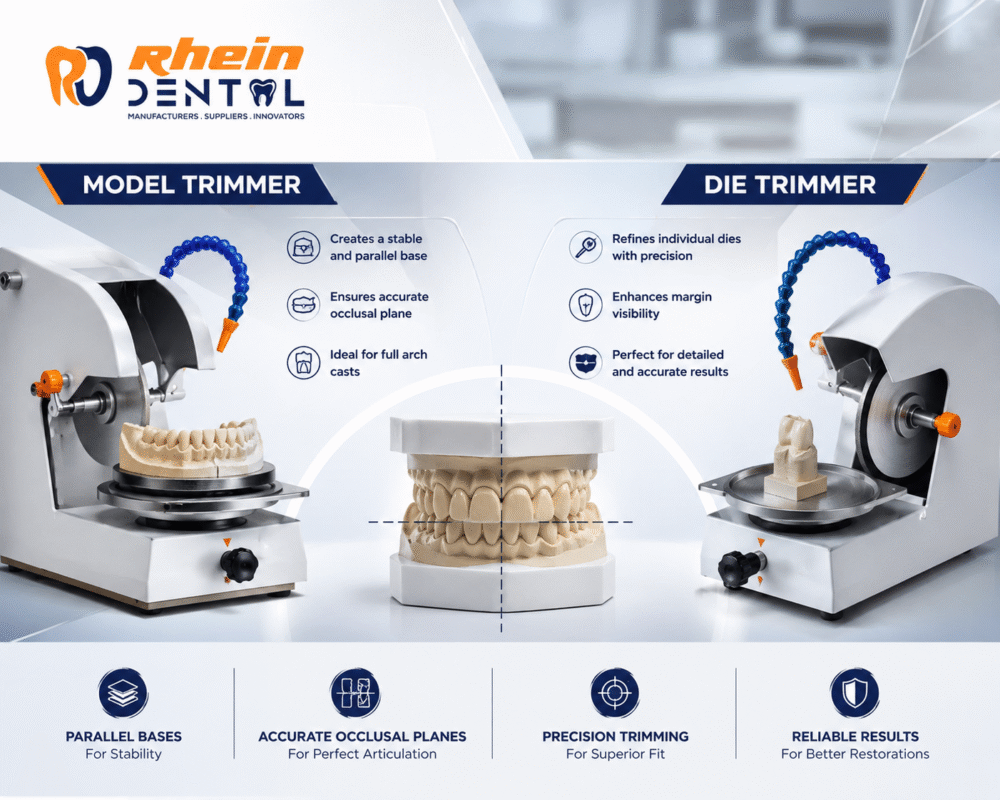
Understanding the Role of Gypsum Cast Trimming
Before diving into instrument differences, it is important to understand why trimming matters.
After impressions are poured into dental stone, the resulting cast is often irregular at the base and bulky around non-essential areas. Without proper trimming:
- The cast may sit unevenly on the bench
- Orientation becomes inconsistent
- Occlusal relationships can be misinterpreted
- Laboratory procedures become less accurate
This is where die trimmers and model trimmers come into play—they convert rough casts into clinically usable diagnostic and working models.
What Are Model Trimmers?
A Model Trimmer is a large, water-cooled grinding instrument designed to shape and level the base of a full dental cast.
Its primary purpose is to create a flat, stable, and properly oriented base, ensuring that the occlusal plane is correctly aligned for diagnostic and restorative work.
Key Features of Model Trimmers
- Large abrasive grinding wheel
- Continuous water spray cooling system
- Adjustable working angles
- Designed for full arch models
- Removes bulk gypsum efficiently
Clinical Purpose
Model trimmers are mainly used to:
- Flatten the base of full arch casts
- Establish a stable horizontal reference plane
- Standardize occlusal orientation across multiple models
- Improve handling and storage of casts
In essence, the model trimmer focuses on global orientation and stability.
What Are Die Trimmers?
A Die Trimmer is a smaller, more precise instrument used specifically for trimming individual dies or sectional models.
Unlike model trimmers, die trimmers are designed for fine adjustments and precision angulation, particularly around prepared tooth areas.
Key Features of Die Trimmers
- Smaller grinding wheel for controlled trimming
- Adjustable angles for precision contouring
- Water cooling system for heat control
- Designed for localized trimming of dies
- Higher accuracy for margin exposure
Clinical Purpose
Die trimmers are used to:
- Refine individual tooth preparations
- Expose margins clearly for restoration fabrication
- Remove excess stone around prepared teeth
- Adjust angulation of dies for optimal visibility
- Ensure precise contour definition for crowns and bridges
In short, die trimmers focus on detail, precision, and margin clarity.
Die Trimmers vs Model Trimmers: Key Functional Differences
Although both instruments are used in gypsum cast preparation, their roles differ significantly.
| Feature | Model Trimmer | Die Trimmer |
|---|---|---|
| Primary Use | Full cast base trimming | Individual die refinement |
| Scale of Work | Macro (entire model) | Micro (single tooth) |
| Objective | Stability & occlusal plane alignment | Precision & margin exposure |
| Cutting Surface | Large abrasive wheel | Smaller angled wheel |
| Accuracy Level | Moderate to high | Very high |
| Clinical Outcome | Stable, level cast | Highly detailed die preparation |
The simplest way to understand the difference is:
- Model trimmer = structural foundation
- Die trimmer = precision detailing
Achieving Parallel Bases with Model Trimmers
One of the most critical goals in cast preparation is achieving a parallel base. This ensures that the model sits uniformly on flat surfaces, which is essential for accurate diagnosis and articulation.
Why Parallel Bases Matter
- Prevents tilting during articulation
- Ensures reproducible occlusal relationships
- Improves mounting accuracy on articulators
- Enhances laboratory workflow consistency
How Model Trimmers Help
Model trimmers allow technicians to:
- Grind the base evenly at controlled angles
- Maintain symmetry across the entire cast
- Align the occlusal plane parallel to the base
- Remove excess gypsum without distorting anatomy
Proper technique ensures that the cast becomes a reliable reference model throughout the restorative process.
Precision Occlusal Planes in Dental Modeling
The occlusal plane is a key reference in prosthodontics, and its accuracy directly impacts prosthetic fit and function.
Model trimmers play a major role in:
- Aligning the occlusal plane parallel to the base
- Ensuring symmetry between maxillary and mandibular models
- Supporting correct articulation on semi-adjustable articulators
Even minor deviations in trimming can lead to:
- Occlusal discrepancies
- Improper bite registration
- Adjustments in final restorations
This is why controlled trimming is not just a laboratory step—it is a clinical necessity.
Die Trimmers in Margin Visibility and Restoration Accuracy
While model trimmers handle the foundation, die trimmers ensure that clinical details are preserved and enhanced.
Key Advantages in Clinical Workflow
- Clear exposure of preparation margins
- Improved visualization for crown fabrication
- Reduced risk of over-trimming or damage
- Enhanced precision in wax-up and CAD/CAM workflows
In modern prosthodontics, die accuracy is directly tied to restoration success. Even a small error at this stage can affect marginal fit and long-term durability.
Clinical Importance in Modern Dental Laboratories
Both instruments remain indispensable despite advancements in digital dentistry.
They are especially critical in:
- Fixed prosthodontics (crowns and bridges)
- Diagnostic model preparation
- Implant planning casts
- Orthodontic study models
- Educational training in dental schools
Even in CAD/CAM workflows, physical models are still widely used for verification and adjustments.
Best Practices for Optimal Results
To achieve consistent and accurate results:
For Model Trimmers:
- Use steady, controlled movements
- Avoid excessive pressure on the wheel
- Maintain consistent water flow
- Check base flatness regularly
For Die Trimmers:
- Work at controlled angles for margin preservation
- Avoid over-trimming cervical areas
- Frequently inspect margin exposure
- Use light, precise contact with the wheel
Proper handling significantly extends instrument life and improves accuracy.
Conclusion
Die trimmers and model trimmers are fundamental tools in dental laboratory science, each serving a unique but complementary role. While model trimmers ensure a stable, parallel base and accurate occlusal orientation, die trimmers focus on fine-detail refinement and precise margin exposure.
Together, they form the backbone of accurate gypsum cast preparation—bridging the gap between impression and final restoration with precision, consistency, and clinical reliability.