
In restorative dentistry, precision during cavity preparation directly influences the success, longevity, and aesthetics of restorations. Among the specialized hand instruments used for refining cavity walls and margins, Margin Trimmers and Gingival Margin Trimmers (GMTs) play an essential role. Although these instruments may appear similar at first glance, their design, cutting angles, and clinical applications differ significantly (Margin Trimmers vs Gingival Margin Trimmers).
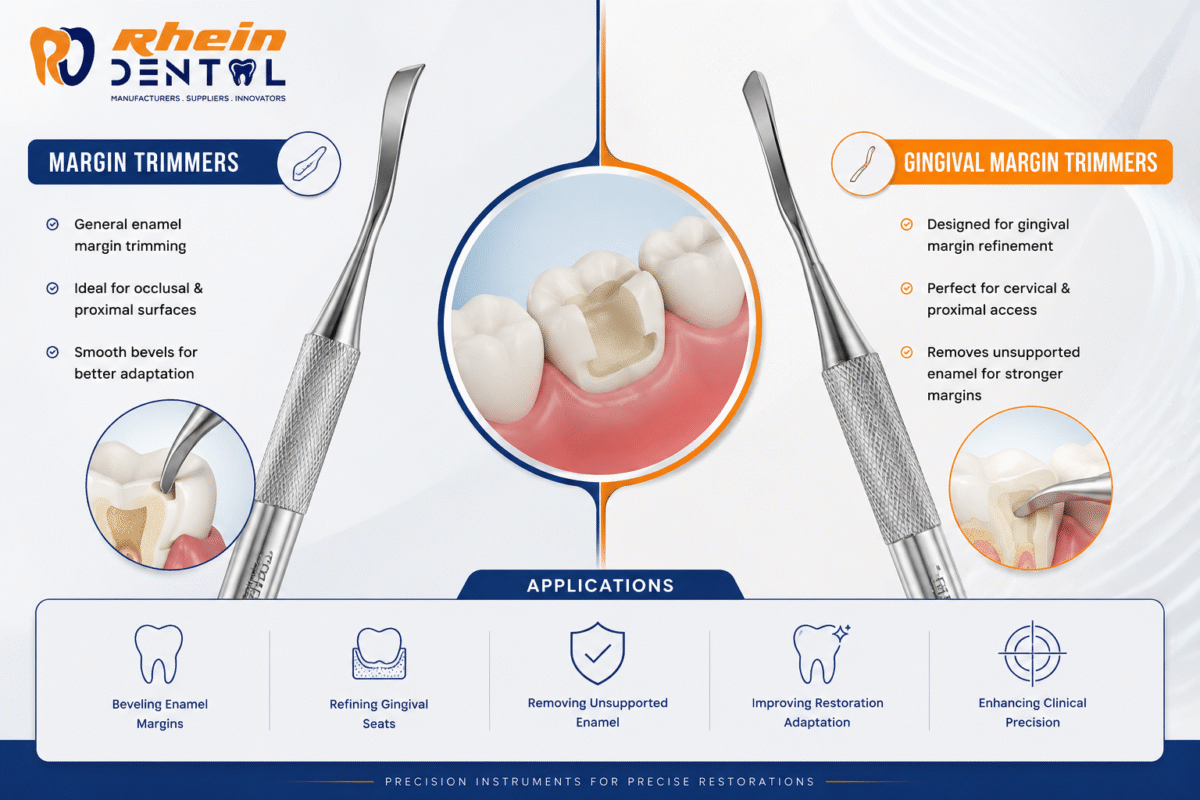
Understanding the functional differences between these instruments helps clinicians improve cavity adaptation, preserve tooth structure, and achieve smoother restorative margins.
What Are Margin Trimmers?
Margin Trimmers are modified enamel hatchets designed primarily for bevelling enamel margins and refining cavity walls. These instruments feature a curved blade with the cutting edge set at an angle other than 90 degrees to the blade axis. This angled design enables controlled trimming and shaping of enamel surfaces during restorative procedures.
Margin trimmers are commonly used in Class II cavity preparations where smooth cavosurface margins are necessary for proper restorative adaptation.
Key Features of Margin Trimmers
- Curved blade design
- Angled cutting edge for precision trimming
- Available in mesial and distal forms
- Designed for push or pull cutting motions
- Helps create clean and smooth enamel margins
What Are Gingival Margin Trimmers?
Gingival Margin Trimmers are a specialized category of margin trimmers specifically developed for shaping and bevelling the gingival floor of proximal cavity preparations. These instruments are especially useful in areas where conventional instruments cannot efficiently access the gingival seat.
GMTs help remove unsupported enamel and improve marginal integrity at the gingival margin, which is critical for reducing microleakage and enhancing restoration longevity.
Key Features of Gingival Margin Trimmers
- Curved blade adapted for gingival access
- Cutting edge angled for cervical and proximal trimming
- Available as mesial GMT and distal GMT
- Designed to improve adaptation of restorative materials
- Ideal for refining gingival cavosurface margins
Functional Differences Between Margin Trimmers and Gingival Margin Trimmers
Although both instruments belong to the same family, their clinical purposes differ considerably.
| Feature | Margin Trimmers | Gingival Margin Trimmers |
|---|---|---|
| Primary Function | General enamel margin trimming | Refinement of gingival margins |
| Working Area | Occlusal and proximal surfaces | Gingival floor of Class II cavities |
| Blade Curvature | Moderate curvature | More pronounced curvature |
| Clinical Focus | Beveling enamel margins | Removing unsupported gingival enamel |
| Accessibility | General cavity refinement | Access to cervical and proximal regions |
The main distinction lies in the working area and blade angulation. Gingival margin trimmers are more specialized for cervical adaptation and proximal cavity refinement.
Clinical Applications in Cavity Preparation
1. Beveling Enamel Margins
Margin trimmers help create smooth bevels that improve the marginal seal of restorations. Proper beveling increases bonding surface area and enhances the aesthetic blending of composite restorations.
2. Refining Gingival Seats
Gingival margin trimmers are highly effective for shaping gingival floors in Class II cavity preparations. They assist in producing flat, smooth surfaces for better restorative adaptation.
3. Removing Unsupported Enamel
Both instruments help eliminate weak enamel rods that may fracture after restoration placement. This contributes to stronger margins and reduced restoration failure.
4. Improving Restoration Adaptation
Properly finished cavity margins allow restorative materials to fit more accurately, minimizing marginal gaps and reducing the risk of recurrent caries.
5. Enhancing Clinical Precision
These instruments provide greater tactile control compared to rotary instruments, especially in conservative cavity preparations.
Mesial vs Distal Gingival Margin Trimmers
GMTs are manufactured in mesial and distal configurations to accommodate different cavity orientations.
- Mesial GMT: Used for mesial cavity walls
- Distal GMT: Used for distal cavity walls
The instrument’s cutting edge orientation determines its suitability for specific preparation areas. Selecting the correct configuration improves efficiency and operator control.
Importance in Modern Restorative Dentistry
Despite the growing use of rotary and ultrasonic instruments, hand instruments like margin trimmers and gingival margin trimmers remain indispensable. They offer unmatched tactile sensitivity and precision for fine cavity refinement.
These instruments are particularly valuable in:
- Conservative restorative procedures
- Pediatric dentistry
- Operative dentistry training
- Finishing proximal cavity preparations
- Composite and amalgam restorations
Instrument Maintenance and Care
To maintain optimal performance:
- Sharpen blades regularly
- Sterilize according to clinical protocols
- Store instruments carefully to avoid edge damage
- Inspect cutting edges routinely for wear
Well-maintained cutting instruments improve procedural accuracy and reduce operator fatigue.
Conclusion
Margin Trimmers and Gingival Margin Trimmers are essential operative instruments that contribute significantly to precise cavity preparation and restorative success. While margin trimmers are designed for general enamel margin refinement, gingival margin trimmers specialize in shaping gingival floors and proximal margins.
Understanding their functional differences allows clinicians to select the appropriate instrument for each restorative step, ultimately improving restoration fit, durability, and patient outcomes.