
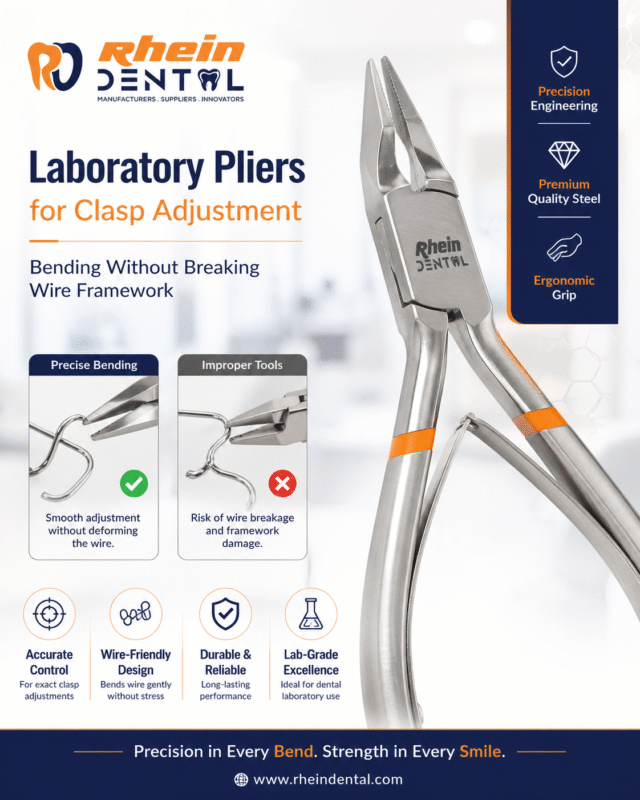
In modern dental prosthetics, precision is everything. Even a minor distortion in a clasp can affect the fit, comfort, and long-term success of a removable partial denture. That’s where laboratory pliers for clasp adjustment come in—specialized instruments designed to bend wire frameworks smoothly, accurately, and most importantly, without causing fractures or weakening the metal.
Understanding Clasp Adjustment in Dental Work
Clasps are small yet critical components of removable partial dentures. They provide retention by gently gripping the natural tooth structure. However, every patient’s oral anatomy is different, which means clasps often require careful adjustment during fabrication or fitting.
The challenge lies in modifying the wire framework without:
- Creating stress points
- Damaging metal fatigue resistance
- Distorting the overall prosthetic fit
Improper bending can easily lead to cracks, breakage, or reduced lifespan of the appliance.
What Makes Laboratory Pliers Different?
Unlike standard pliers, laboratory pliers for clasp adjustment are engineered specifically for controlled manipulation of orthodontic and prosthetic wires.
Their design focuses on three key principles:
1. Precision Grip Control
The jaws are shaped to hold wires firmly without slipping, allowing technicians to apply controlled pressure exactly where needed.
2. Smooth Surface Contact
Highly polished or specially coated tips reduce surface damage on the wire, preventing micro-cracks that could later lead to failure.
3. Force Distribution Design
The structure of these pliers ensures even distribution of force across the wire, reducing stress concentration at a single point.
Why “Bending Without Breaking” Matters
Metal frameworks used in dental appliances are often made of stainless steel or cobalt-chromium alloys. While these materials are strong, they are also susceptible to work hardening.
Repeated or improper bending can cause:
- Loss of elasticity
- Increased brittleness
- Sudden fracture during use
Laboratory pliers solve this problem by enabling gradual, controlled bending, preserving the structural integrity of the wire.
Common Types of Clasp Adjustment Pliers
Different clinical situations require different tools. Some commonly used types include:
1. Three-Jaw Pliers
Ideal for uniform bending and minor adjustments in clasp arms.
2. Loop Forming Pliers
Used for creating precise loops or curves without flattening the wire.
3. Round-Nose Pliers
Best for smooth, circular bends and detailed shaping of wire ends.
4. Flat-Edge Adjustment Pliers
Designed for broader contact and controlled pressure application on flat sections.
Each type plays a unique role in ensuring the final prosthetic fits perfectly and functions comfortably.
Key Benefits in Dental Laboratory Practice
Using proper clasp adjustment pliers offers several important advantages:
- Improved Accuracy: Enables fine-tuned modifications without guesswork
- Material Safety: Reduces risk of wire fatigue and breakage
- Time Efficiency: Minimizes repeated adjustments
- Better Patient Comfort: Ensures smoother fit and reduced irritation
- Long-Term Durability: Enhances lifespan of dental appliances
Techniques for Safe Wire Bending
Even with the right tools, technique matters. Skilled technicians follow these best practices:
- Apply gradual pressure instead of sudden force
- Avoid bending at the same point repeatedly
- Support both ends of the wire during adjustment
- Use the correct plier type for each adjustment stage
- Inspect wire under magnification when needed
These steps ensure that the framework retains its strength and precision.
The Role of Quality Instruments in Dental Success
The performance of laboratory pliers directly impacts the final outcome of prosthetic work. High-quality instruments ensure:
- Consistent results across cases
- Reduced risk of remakes
- Higher patient satisfaction
- Better collaboration between clinician and technician
In dental labs, precision tools are not just accessories—they are foundational to success.
Final Thoughts
Laboratory pliers for clasp adjustment may seem like simple hand tools, but they play a crucial role in modern prosthodontics. Their ability to bend wire frameworks without breaking them ensures accuracy, durability, and patient comfort.
As dental technology continues to advance, the demand for precision instruments will only grow. For technicians and clinicians alike, mastering these tools is essential for delivering reliable and long-lasting dental solutions.