
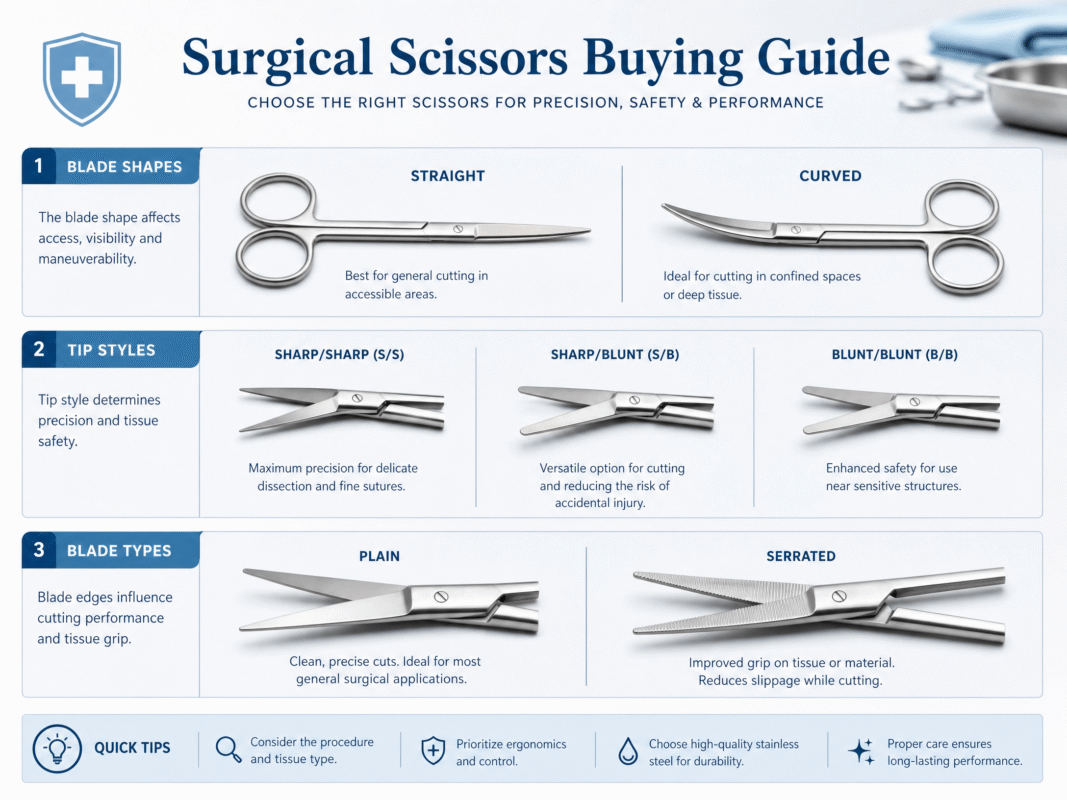
Surgical scissors are among the most frequently used instruments in medical, dental, veterinary, and laboratory settings. While they may appear similar at first glance, every pair is designed for a specific purpose. Blade shape, blade curvature, and tip style all affect cutting precision, tissue handling, visibility, and overall surgical efficiency(Surgical Scissors Buying Guide).
Choosing the wrong scissors can lead to poor cutting performance, unnecessary tissue trauma, or instrument damage. This guide explains the differences between blade shapes, curved and straight designs, and tip styles so you can confidently select the right surgical scissors for every procedure(Surgical Scissors Buying Guide).
Why Choosing the Right Surgical Scissors Matters
Every surgical procedure requires controlled, precise cutting. Whether you’re trimming sutures, dissecting delicate tissue, or cutting heavy materials, the correct scissors improve:
- Cutting accuracy
- Surgical visibility
- Tissue preservation
- Operator comfort
- Procedural efficiency
- Instrument longevity
Instead of using one pair for every task, professionals typically keep several specialized scissors available for different applications.
Understanding Surgical Scissor Anatomy
Before selecting a pair, it’s helpful to understand the key parts.
Blades
The cutting edges that perform the actual cut.
Tips
The ends of the blades, which determine how safely and accurately scissors enter tissue.
Shanks
The long section connecting the blades to the handles.
Finger Rings
Provide grip and control during cutting.
Joint (Box Lock or Screw Joint)
Allows smooth blade movement while maintaining alignment.
Each component contributes to cutting performance and handling characteristics.
Choosing the Right Blade Shape
Blade shape is one of the biggest factors affecting cutting performance.
Straight Blades
Straight scissors are designed for cutting materials that are easily visible.
They provide:
- Excellent control
- Clean, accurate cuts
- Easy alignment
- Fast trimming
Common uses include:
- Cutting sutures
- Surgical drapes
- Dressings
- Tubing
- Surgical gauze
Straight scissors are generally not intended for deep tissue dissection.
Curved Blades
Curved blades improve access beneath tissue layers.
Their design allows surgeons to:
- Work around anatomical structures
- Maintain better visibility
- Separate tissues more easily
- Perform controlled dissection
Curved scissors are widely used during:
- Soft tissue dissection
- Oral surgery
- General surgery
- Plastic surgery
- Veterinary procedures
The upward curve also helps keep hands out of the surgical field, improving visibility.
Angled Blades
Some specialty scissors feature angled blades that improve access to confined or difficult surgical sites.
Benefits include:
- Better approach angles
- Improved access
- Reduced hand obstruction
- Increased precision
These are commonly found in microsurgical and specialty surgical instruments.
Straight vs Curved Surgical Scissors
| Straight Scissors | Curved Scissors |
|---|---|
| Best for surface cutting | Best for tissue dissection |
| Ideal for sutures | Ideal for soft tissue |
| Excellent visibility | Better access beneath tissue |
| Easier material trimming | Greater surgical precision |
| Used outside body cavities | Frequently used inside surgical sites |
Many surgical trays include both styles because each serves a different purpose.
Choosing the Right Tip Style
Tip configuration is equally important because it determines how safely scissors enter tissue.
Blunt-Blunt Tips
Both blade ends are rounded.
Advantages include:
- Reduced accidental puncture
- Greater patient safety
- Ideal for dressings
- Safer near delicate structures
Common applications:
- Bandage scissors
- Dressing changes
- General nursing
- Emergency care
Sharp-Sharp Tips
Both tips taper to fine points.
Benefits include:
- Highly precise entry
- Fine dissection
- Controlled cutting
- Detailed surgical work
Often used for:
- Plastic surgery
- Ophthalmic procedures
- Microsurgery
- Delicate tissue work
These require experienced handling due to their sharp points.
Sharp-Blunt Tips
One blade is pointed while the other is rounded.
This combination provides:
- Easy tissue entry
- Lower risk of injury
- Controlled cutting
- Greater versatility
Widely used during:
- General surgery
- Minor procedures
- Soft tissue dissection
Matching Blade Curvature to Surgical Tasks
Choosing the correct blade curve improves both safety and efficiency.
Minimal Curve
Suitable for:
- General tissue cutting
- Routine procedures
- Controlled trimming
Moderate Curve
Offers excellent visibility during:
- Dental surgery
- Soft tissue dissection
- Oral procedures
- General surgical applications
Deep Curve
Ideal for:
- Deep surgical sites
- Restricted access
- Complex dissections
- Veterinary surgery
Matching Scissors to Common Procedures
Suture Removal
Recommended features:
- Straight blades
- Fine tips
- Sharp lower blade
- Small cutting surface
Designed for quick, accurate suture removal.
Soft Tissue Dissection
Recommended features:
- Curved blades
- Fine cutting edges
- Sharp or sharp-blunt tips
Allows controlled separation without excessive tissue damage.
Cutting Dressings
Recommended features:
- Blunt-blunt tips
- Strong blades
- Straight design
Protects skin while cutting bandages or clothing.
Delicate Microsurgery
Recommended features:
- Fine blades
- Sharp-sharp tips
- Lightweight construction
Provides exceptional precision in confined surgical fields.
Heavy Tissue Cutting
Recommended features:
- Thick blades
- Strong joint
- Curved design
Suitable for dense tissue encountered during larger procedures.
Material Quality Matters
Even the best blade design performs poorly if the material is inferior.
High-quality surgical scissors are typically manufactured from:
- Premium stainless steel
- German stainless steel
- Tungsten carbide insert blades (for extended sharpness)
Benefits include:
- Superior corrosion resistance
- Long-lasting sharp edges
- Smooth cutting action
- Easier sterilization
- Longer instrument lifespan
Signs You’re Using the Wrong Scissors
If you notice any of the following, your scissors may not be appropriate for the task:
- Tissue tearing instead of clean cutting
- Excessive hand force required
- Poor visibility during dissection
- Difficulty reaching the target area
- Jagged or uneven cuts
- Frequent blade dulling
Selecting the correct blade configuration often resolves these issues.
Maintenance Tips for Longer Performance
Proper care extends the life of surgical scissors.
Best practices include:
- Clean immediately after use.
- Remove biological debris before sterilization.
- Lubricate joints regularly.
- Avoid cutting materials beyond the instrument’s intended purpose.
- Inspect blade alignment routinely.
- Store scissors in protective instrument trays.
- Replace damaged or dull scissors promptly.
Routine maintenance ensures consistent cutting performance and reduces replacement costs.
Final Thoughts
Selecting the right surgical scissors involves more than choosing a size. Blade shape, curvature, and tip style all play a critical role in achieving precise, safe, and efficient cutting. Straight scissors excel at surface cutting and suture removal, while curved designs offer better visibility and control during tissue dissection. Likewise, blunt, sharp, and combination tips are each engineered for specific clinical applications.
By understanding these design features, healthcare professionals can build a versatile instrument set that supports a wide range of procedures while improving surgical outcomes and preserving tissue integrity.