
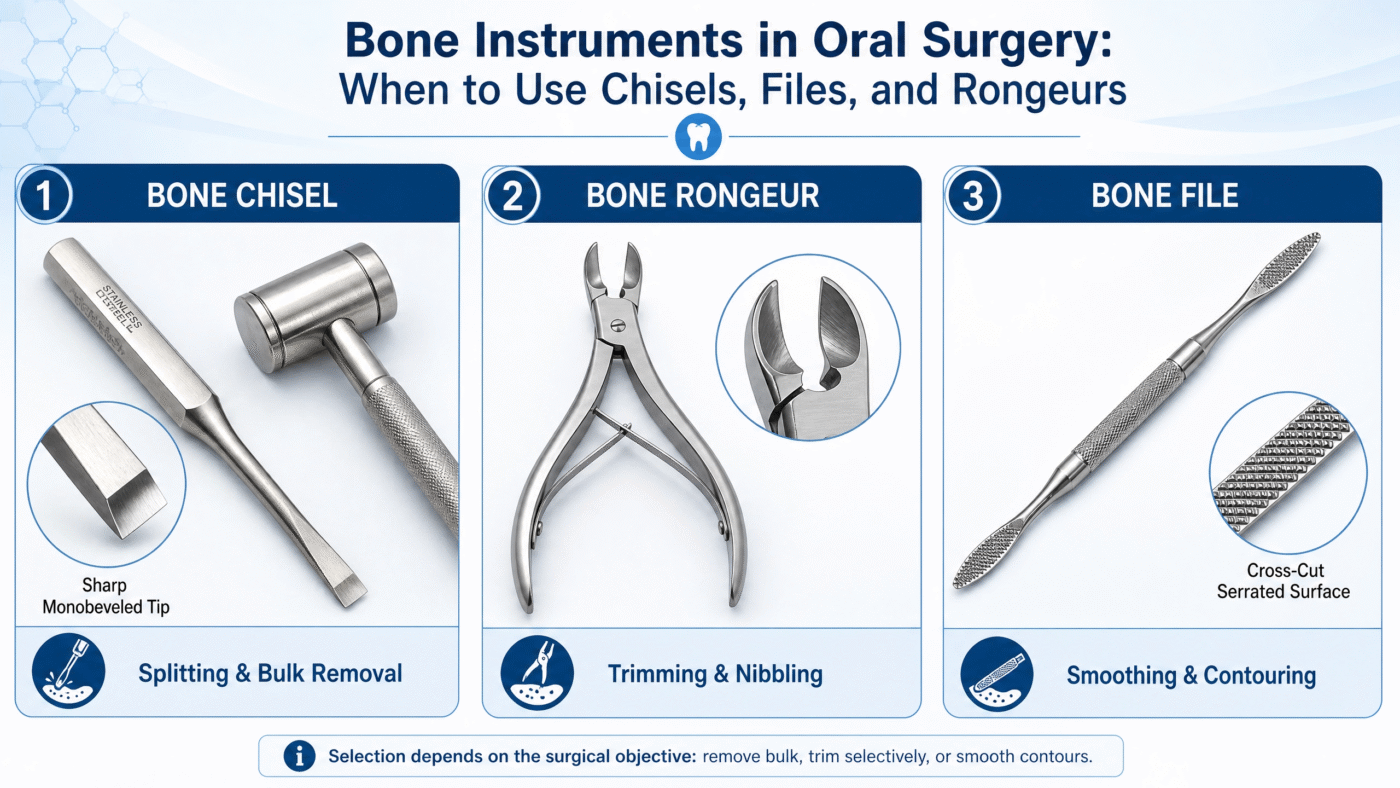
Bone management is one of the most critical aspects of oral and maxillofacial surgery. Whether performing tooth extractions, alveoloplasty, implant site preparation, or removing pathological bone, selecting the correct bone instruments in oral surgery directly influences surgical precision, patient safety, and healing outcomes (Bone Instruments in Oral Surgery).
Among the most commonly used instruments are bone chisels, bone files, and bone rongeurs. While they all modify bone, each serves a unique purpose during different stages of surgery. Using the wrong instrument can lead to unnecessary trauma, prolonged surgical time, and compromised results (Bone Instruments in Oral Surgery).
This comprehensive guide explains when to use chisels, files, and rongeurs, their advantages, limitations, maintenance requirements, and how to choose the right instrument for every clinical procedure.
Why Bone Instruments Matter in Oral Surgery
Bone is a living tissue that requires careful handling during surgical procedures. Excessive force or improper instrumentation can cause:
- Bone fractures
- Heat generation
- Delayed healing
- Soft tissue injury
- Reduced implant stability
- Increased postoperative discomfort
Selecting the appropriate instrument ensures:
- Controlled bone removal
- Preservation of healthy tissue
- Faster procedures
- Improved visibility
- Better healing outcomes
- Predictable surgical results
Understanding Bone Instruments in Oral Surgery
Bone instruments are specialized surgical tools designed to cut, contour, smooth, remove, or reshape hard tissue.
The three primary categories include:
- Bone Chisels
- Bone Files
- Bone Rongeurs
Each performs a completely different function despite working on bone.
Bone Chisels: Precision Bone Cutting
What Is a Bone Chisel?
A bone chisel is a sharp-edged surgical instrument designed for controlled cutting and splitting of bone using hand pressure or a surgical mallet.
Unlike rotary instruments, chisels remove bone with minimal heat generation.
Primary Uses
Bone chisels are commonly used for:
- Removing cortical bone
- Splitting alveolar ridges
- Sectioning bone
- Bone graft harvesting
- Osteoplasty
- Surgical access creation
Common Procedures Using Bone Chisels
Impacted Tooth Surgery
Bone surrounding impacted teeth is carefully removed before extraction.
Ridge Splitting
Chisels help widen narrow alveolar ridges before implant placement.
Bone Grafting
Used for harvesting autogenous cortical bone blocks.
Alveoloplasty
Precise contouring following multiple extractions.
Advantages of Bone Chisels
- Excellent tactile feedback
- Minimal thermal injury
- Highly precise bone cutting
- Reduced dependence on rotary equipment
- Cost-effective
- Suitable for delicate procedures
Limitations
- Technique sensitive
- Requires surgical experience
- Often needs a mallet
- Less efficient for large-volume bone removal
Types of Bone Chisels
Several designs exist depending on surgical requirements.
Straight Bone Chisel
Ideal for direct cutting.
Curved Bone Chisel
Improves access in posterior regions.
Single-Bevel Chisel
Provides controlled directional cutting.
Double-Bevel Chisel
Suitable for general bone shaping.
Bone Files: Smoothing and Finishing Bone
What Is a Bone File?
A bone file is a finishing instrument used after bone cutting to smooth rough edges and remove small irregularities.
Unlike chisels or rongeurs, files do not remove significant bone volume.
When Are Bone Files Used?
Bone files are commonly used after:
- Alveoloplasty
- Tooth extractions
- Bone trimming
- Exostosis removal
- Implant osteotomy refinement
- Tori removal
Their primary purpose is creating smooth bone surfaces before flap closure.
Clinical Benefits
Bone files help:
- Prevent soft tissue irritation
- Improve flap adaptation
- Reduce postoperative discomfort
- Eliminate sharp bony spicules
- Enhance healing
Types of Bone Files
Single-Ended Bone File
Ideal for confined surgical fields.
Double-Ended Bone File
Provides versatility during surgery.
Cross-Cut Bone File
Offers faster smoothing efficiency.
Proper Technique for Bone Filing
Effective filing requires controlled strokes.
General recommendations include:
- Pull rather than push
- Maintain light pressure
- Frequently irrigate
- Remove debris regularly
- Check bone smoothness visually and manually
Aggressive filing may unnecessarily remove healthy bone.
Bone Rongeurs: Rapid Bone Removal
What Is a Bone Rongeur?
A bone rongeur is a heavy-duty cutting instrument featuring sharp jaws that bite away small sections of bone.
It functions similarly to a punch cutter.
Primary Uses
Bone rongeurs are ideal for:
- Removing thin cortical bone
- Alveoloplasty
- Eliminating bone spicules
- Access creation
- Bone contouring
- Removing bony undercuts
Procedures Where Rongeurs Excel
Multiple Tooth Extractions
Rapid reshaping of the alveolar ridge.
Denture Preparation
Removing sharp bone before prosthetic fabrication.
Tori Removal
Eliminating excess bone prior to finishing.
Oral Pathology Surgery
Improving surgical access.
Advantages of Bone Rongeurs
- Fast bone removal
- Excellent control
- Strong cutting force
- Efficient contouring
- Minimal equipment requirements
Limitations
- Less precise than chisels
- Not ideal for delicate bone cuts
- Requires adequate access
- May leave rough bone surfaces requiring a file
Types of Bone Rongeurs
Common designs include:
Blumenthal Rongeur
Excellent for oral surgery and alveoloplasty.
Luer Rongeur
Versatile for general bone trimming.
Stille Rongeur
Heavy-duty bone removal.
Side-Cutting Rongeur
Useful in difficult anatomical locations.
Chisels vs Bone Files vs Rongeurs
| Feature | Bone Chisel | Bone File | Bone Rongeur |
|---|---|---|---|
| Primary Function | Cut bone | Smooth bone | Remove bone |
| Precision | Very High | High | Moderate |
| Bone Removal Speed | Moderate | Low | High |
| Heat Generation | Minimal | None | None |
| Best For | Osteotomy | Finishing | Alveoloplasty |
| Requires Mallet | Often | No | No |
Choosing the Right Bone Instrument
Instrument selection depends on several clinical factors.
Nature of the Procedure
Different surgeries require different instruments.
Examples include:
- Impacted extraction → Chisel + Rongeur + Bone File
- Implant surgery → Chisel + Bone File
- Alveoloplasty → Rongeur + Bone File
- Bone graft harvesting → Chisel
- Ridge contouring → Rongeur + File
Bone Density
Dense cortical bone often benefits from chisels.
Thin cancellous bone can frequently be managed using rongeurs.
Surgical Access
Confined surgical fields may require:
- Curved chisels
- Small rongeurs
- Fine bone files
Desired Precision
Fine contouring demands:
- Bone files
- Small chisels
Rapid reduction favors:
- Rongeurs
Combining Instruments for Better Outcomes
Most oral surgeries involve more than one bone instrument.
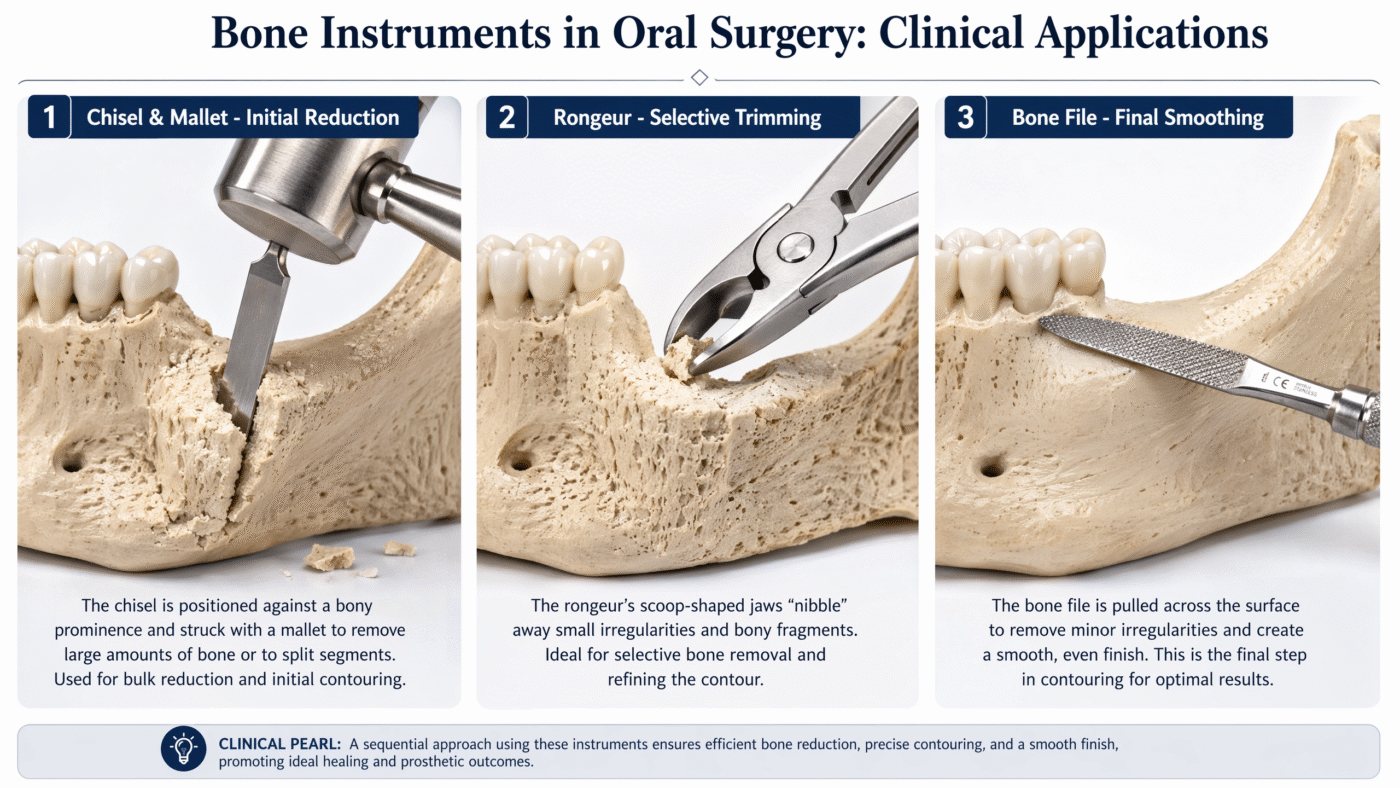
A typical sequence includes:
- Bone removal using a rongeur
- Precision refinement with a chisel
- Final smoothing using a bone file
This workflow minimizes tissue trauma while improving efficiency.
Instrument Care and Maintenance
Proper maintenance preserves cutting efficiency and extends instrument lifespan.
Best practices include:
- Immediate cleaning after surgery
- Ultrasonic cleaning when appropriate
- Thorough drying before sterilization
- Routine inspection for wear
- Regular sharpening of cutting edges
- Proper lubrication of hinged rongeurs
- Storage in protective instrument cassettes
Damaged instruments should be repaired or replaced promptly.
Common Mistakes to Avoid
Even experienced clinicians can encounter issues if instruments are misused.
Avoid:
- Using dull chisels
- Applying excessive force
- Filing aggressively
- Using rongeurs for precision cuts
- Neglecting irrigation
- Failing to inspect bone smoothness before closure
Proper technique minimizes complications and improves patient outcomes.
Innovations in Bone Instruments
Modern oral surgery continues to advance with improved instrument designs.
Current innovations include:
- Tungsten carbide cutting edges
- Ergonomic handles
- Lightweight stainless steel construction
- Enhanced corrosion resistance
- Improved balance for precision control
- Better sterilization compatibility
These advancements increase efficiency while reducing operator fatigue.
Final Thoughts
Mastering the use of bone chisels, bone files, and bone rongeurs is fundamental to successful oral surgery. Although these instruments share the common goal of bone management, each is designed for a specific stage of treatment. Chisels deliver controlled bone cutting, rongeurs provide efficient bone removal, and files refine the surgical site for optimal healing.
By understanding the strengths of each instrument and using them in combination when appropriate, clinicians can improve surgical precision, minimize tissue trauma, reduce operating time, and achieve more predictable patient outcomes. Selecting high-quality, well-maintained bone instruments is an essential investment in both surgical performance and long-term clinical success.
Frequently Asked Questions
What is the difference between a bone chisel and a bone rongeur?
A bone chisel cuts or splits bone with precision, while a bone rongeur removes larger portions of bone quickly by biting through thin cortical bone. Chisels are ideal for controlled osteotomy, whereas rongeurs are preferred for rapid contouring and alveoloplasty.
When should a bone file be used?
A bone file should be used after bone cutting or trimming to smooth rough edges, eliminate bone spicules, and create a polished surface before suturing. This helps improve flap adaptation and patient comfort.
Are bone chisels still used with rotary instruments available?
Yes. Bone chisels remain valuable because they provide excellent tactile control, generate minimal heat, and allow precise bone cutting in procedures such as ridge splitting, bone graft harvesting, and osteoplasty.
Can a rongeur replace a bone file?
No. A rongeur removes bone efficiently but often leaves an uneven surface. A bone file is required afterward to smooth the bone and reduce the risk of soft tissue irritation.
Which bone instrument is best for alveoloplasty?
Alveoloplasty typically involves a combination of instruments. A bone rongeur is used for rapid bone reduction, followed by a bone.