
Endo Motor Programming Tips – Mastering Endodontic Motor Settings
Endodontic motors have transformed the way clinicians perform root canal treatments. With precision control, consistent torque, and programmable settings, these devices enhance both safety and efficiency during endodontic procedures. However, to unlock their full potential, understanding endo motor programming is essential. In this guide, we’ll explore practical endo motor programming tips, explain the importance of correct motor settings, and share recommendations to help you optimize your workflow.
Why Endo Motor Programming Matters
Each tooth, canal curvature, and file system demands a specific approach. Incorrect settings can lead to:
- File separation or distortion
- Excessive dentin removal
- Incomplete cleaning and shaping
By fine-tuning your motor’s torque, speed, and motion mode, you ensure safer instrumentation and predictable results.
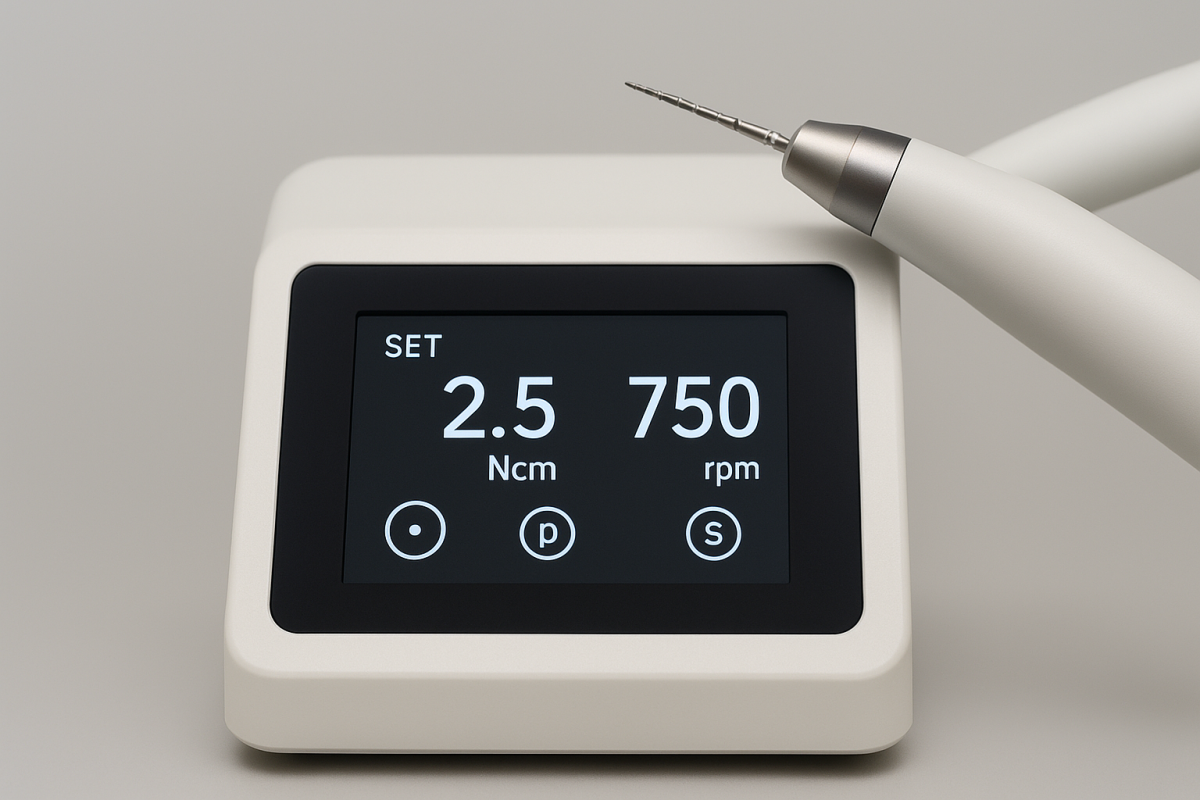
1. Understand Your File System
Every NiTi rotary or reciprocating file system has its own manufacturer-recommended parameters.
Before programming:
- Refer to the file manufacturer’s instruction sheet.
- Note the RPM (rotations per minute) and torque limits specified.
- Identify whether the system operates in continuous rotation or reciprocation.
Example:
| File System | Motion Type | Speed (RPM) | Torque (Ncm) |
|---|---|---|---|
| ProTaper Gold | Continuous rotation | 300 | 2.0 |
| WaveOne Gold | Reciprocation | — | Auto-torque |
| HyFlex EDM | Continuous rotation | 500 | 2.5 |
Tip: Store these settings in your endo motor’s memory channels for quick access during different cases.
2. Optimize Torque Settings
Torque control prevents file breakage.
- Start with manufacturer-recommended torque.
- For calcified or narrow canals, reduce torque slightly to minimize stress.
- When shaping wide or straight canals, a slightly higher torque can improve cutting efficiency.
Tip: Use the auto-reverse function—it automatically reverses rotation when torque exceeds the set limit, protecting both file and canal.
3. Adjust Speed (RPM) with Care
Speed affects both cutting efficiency and debris removal:
- Lower RPM (250–350) – for narrow or curved canals
- Medium RPM (400–500) – for general shaping
- High RPM (600–800) – for coronal flaring or smoother cutting files
Avoid excessive speed, as it increases heat generation and reduces tactile control.
4. Select the Right Motion Mode
Modern endo motors offer several motion options:
- Continuous rotation: Ideal for most rotary systems.
- Reciprocation: Alternates clockwise and counter-clockwise motion to reduce cyclic fatigue.
- Adaptive motion: Adjusts automatically based on canal resistance.
Tip: Match your motion mode to the specific file system design. Never use reciprocating settings with rotary files unless explicitly indicated.
5. Customize Memory Programs
Most endo motors feature programmable memory channels—a huge time-saver in multi-file systems.
Program each channel for:
- File sequence (e.g., Glide Path → Shaping → Finishing)
- Corresponding speed and torque
- Motion type
Label programs clearly (e.g., “ProTaper Gold S1,” “WaveOne Gold Primary”) to avoid confusion during treatment.
6. Maintain and Calibrate Regularly
Even precise motors drift over time. To maintain accuracy:
- Calibrate monthly (or as per manufacturer recommendation).
- Check handpiece integrity and contra-angle wear.
- Keep batteries charged and update firmware if available.
Proper maintenance ensures consistent torque delivery and reliable performance.
7. Use Auto Functions Wisely
Leverage advanced features:
- Auto start/stop: Starts rotation when the file enters the canal.
- Auto torque reverse: Reduces risk of file fracture.
- Auto apical reverse: Stops rotation near working length (in apex locator-integrated motors).
These functions not only enhance safety but also streamline your workflow.
Final Thoughts
Mastering endo motor programming isn’t just about convenience—it’s about precision, safety, and patient outcomes.
By understanding your file systems, optimizing torque and speed, and maintaining your device regularly, you can make the most of modern endodontic technology.