
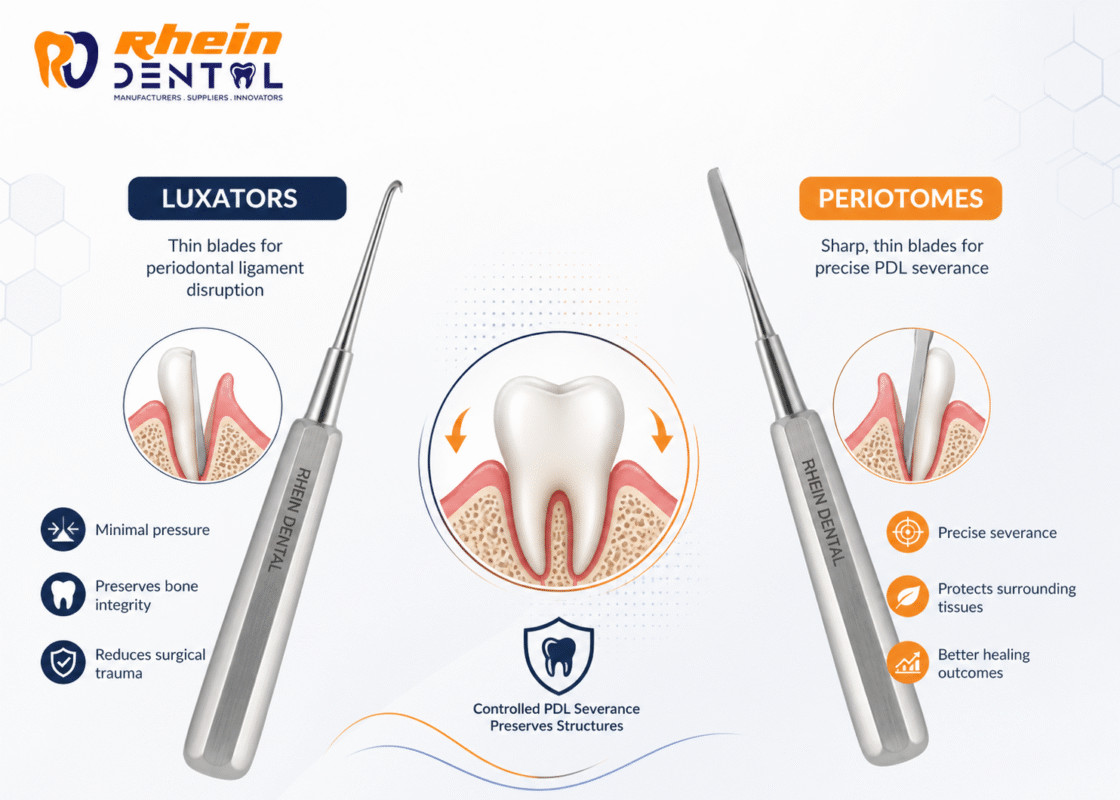
Tooth extraction is never just about force; it is about precision, control, and anatomy-driven design. Because upper and lower molars differ significantly in structure and access, dentists rely on specifically engineered forceps to ensure safe and efficient removal. As a result, understanding these differences becomes essential for both clinical success and patient safety.
Why Molar Anatomy Demands Different Forceps
Molar teeth sit at the back of the mouth, where visibility and access are already limited. However, the real challenge lies beneath the surface—root morphology and bone density vary dramatically between upper and lower jaws.
On one hand, maxillary (upper) molars typically feature three roots and a more porous bone structure. On the other hand, mandibular (lower) molars have two strong roots anchored in denser bone. Therefore, each situation requires a completely different mechanical approach.
Upper Molar Forceps: Precision for Complex Root Systems
Upper molar forceps are designed to adapt to a more delicate and anatomically complex environment.
To begin with, their curved beaks allow better access around the buccal and palatal surfaces. In addition, the asymmetrical design helps clinicians engage multiple roots more effectively during extraction.
Unlike lower molars, upper molars require controlled movements rather than heavy force. Consequently, these forceps support a rocking motion that gently loosens the tooth from its socket.
Moreover, the longer handle-to-beak ratio improves access in the posterior maxilla, where space is naturally restricted by surrounding anatomical structures.
Lower Molar Forceps: Strength for Dense Bone Engagement
Lower molar forceps, in contrast, focus on strength and stability rather than delicate adaptation.
Because mandibular bone is dense and resistant, these forceps are built with straighter and more robust beaks. This design allows deeper engagement into the bifurcated root structure.
Additionally, the symmetrical beak alignment ensures that force is distributed evenly during extraction. As a result, clinicians can apply controlled buccal-lingual and rotational movements with greater efficiency.
Some designs even include a cowhorn feature, which specifically locks into the furcation area for maximum grip and leverage.
Key Differences Between Upper and Lower Molar Forceps
To make the distinction clearer, here is a direct comparison:
| Feature | Upper Molar Forceps | Lower Molar Forceps |
|---|---|---|
| Root structure | Three divergent roots | Two strong roots |
| Bone density | Lighter, cancellous bone | Dense cortical bone |
| Beak shape | Curved and asymmetrical | Straight and symmetrical |
| Movement style | Gentle rocking motion | Rotational and lateral force |
| Design focus | Precision and adaptation | Strength and leverage |
Why Design Differences Improve Clinical Outcomes
When forceps match anatomical requirements, extraction becomes significantly safer and more predictable. However, using the wrong instrument can quickly lead to complications.
For example, excessive force in the maxilla may cause root fracture or sinus complications. Similarly, inadequate grip in the mandible can result in incomplete extraction or bone damage.
Therefore, selecting the correct forceps directly improves:
- Procedural efficiency
- Tissue preservation
- Post-operative healing
- Patient comfort
Ergonomics: The Hidden Advantage in Forceps Design
Modern dental forceps do more than grip teeth—they support the clinician’s hand mechanics.
In fact, ergonomic design reduces wrist strain during repetitive procedures. At the same time, it enhances torque control, especially in lower molar extractions where force demand is higher.
Furthermore, improved handle balance allows smoother transitions between movements, reducing fatigue during longer surgical sessions.
Final Thoughts
Although upper and lower molar forceps may appear similar at first glance, their functional differences are deeply rooted in dental anatomy and biomechanics.
Upper molar forceps prioritize precision and adaptability, while lower molar forceps focus on strength and controlled power. Together, these designs ensure that clinicians can handle even the most complex extractions safely and efficiently.
Ultimately, successful tooth removal depends not just on technique—but on using the right instrument for the right anatomy.