
In long surgical procedures, precision isn’t just about skill—it’s about endurance. And endurance depends heavily on something many clinicians overlook: instrument handle ergonomics (Instrument Handle Ergonomics).
The shape of an instrument shank—whether hex, round, or flat—directly affects how force is applied, how fatigue builds up, and how much control you maintain over time. When surgeries extend beyond the routine, even small ergonomic advantages can translate into better outcomes and reduced strain.
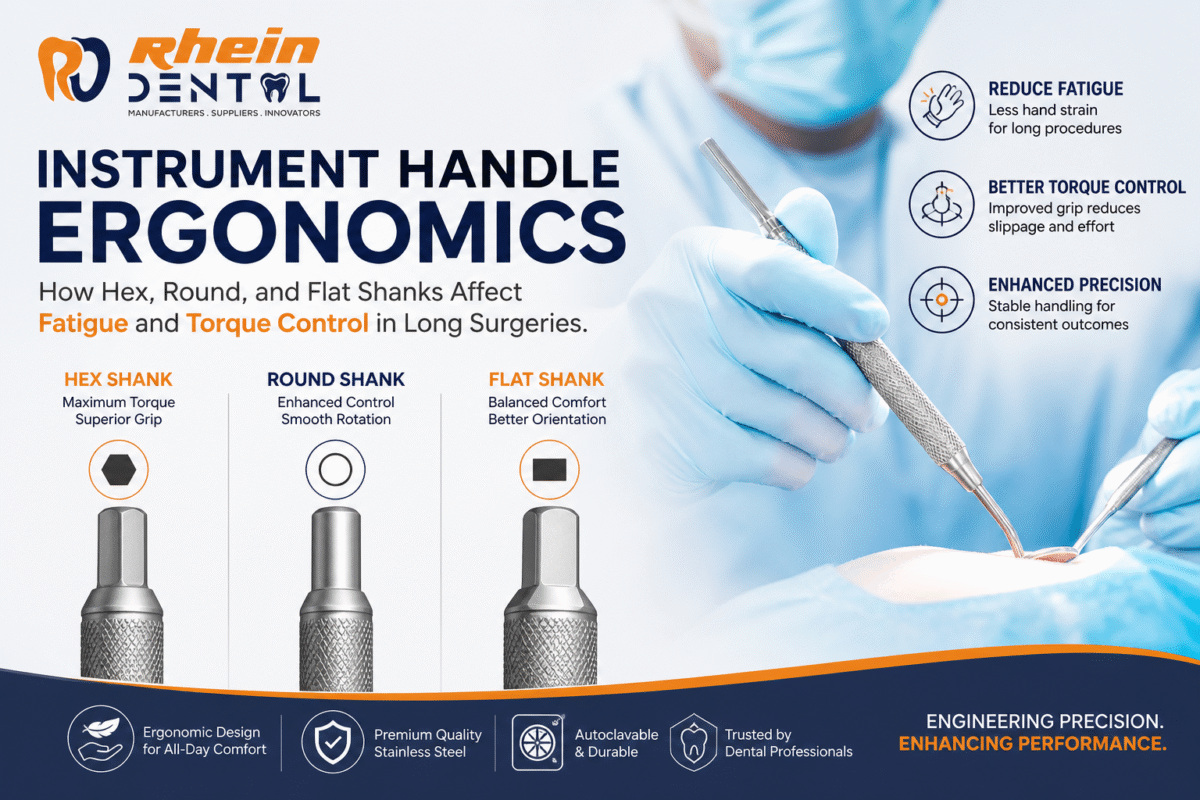
Why Handle Design Becomes Critical in Long Procedures
During extended use, the hand is exposed to repetitive motion, sustained grip force, and constant micro-adjustments. Poorly designed handles can lead to:
- Increased hand and wrist fatigue
- Loss of torque efficiency
- Higher risk of slipping
- Reduced tactile sensitivity
Over time, this doesn’t just affect comfort—it affects precision and safety.
Hex Shanks: Built for Torque and Stability
Hexagonal handles are designed with six flat sides, creating natural grip points.
What makes them effective:
- Superior torque control: Edges provide resistance against rotation
- Reduced slippage: Ideal in wet surgical environments
- Lower grip effort: Less squeezing required to maintain control
Where they fall short:
- Can create pressure hotspots during prolonged use
- Not ideal for rapid finger rolling movements
Best suited for:
- High-force procedures
- Tooth elevation and controlled rotational movements
- Situations where maximum stability is critical
Round Shanks: Designed for Precision and Fluid Motion
Round handles offer a smooth, continuous surface, making them highly adaptable in delicate procedures.
Key advantages:
- Effortless rotation between fingers
- Enhanced tactile feedback for fine control
- Even pressure distribution, reducing localized strain
Limitations:
- Requires more grip force to maintain torque
- Higher risk of slippage without texture
Best suited for:
- Fine surgical work
- Scaling, soft tissue procedures, and precision tasks
- Situations requiring continuous motion and sensitivity
Flat (Oval) Shanks: The Balanced Approach
Flat or oval shanks combine elements of both hex and round designs.
Why clinicians prefer them:
- Improved orientation control (you always know instrument position)
- Moderate torque resistance without aggressive edges
- More comfortable for extended use
Trade-offs:
- Not as torque-efficient as hex
- Not as fluid as round
Best suited for:
- General surgical procedures
- Long sessions requiring both comfort and control
- Clinicians looking for a versatile, all-purpose grip
The Hidden Factors: Texture and Diameter
Handle shape alone isn’t everything. Two additional factors significantly influence performance:
Surface Texture
- Knurling or micro-patterns improve grip in wet conditions
- Reduce the need for excessive force
- Enhance overall control without increasing fatigue
Handle Diameter
- Wider handles reduce muscle strain and pinch force
- Narrow handles offer precision but increase fatigue over time
For long surgeries, a larger diameter with light texturing is often the optimal choice.
How Ergonomics Directly Impacts Fatigue
Fatigue isn’t just about time—it’s about force efficiency.
- The more force required to hold an instrument, the faster fatigue sets in
- Designs that prevent slipping reduce unnecessary muscle activation
- Balanced handles support a neutral wrist posture, minimizing strain
In practice, this means:
- Hex handles conserve energy during torque-heavy steps
- Round handles reduce fatigue during precision work
- Flat handles provide sustainable comfort across mixed tasks
Practical Strategy: Don’t Rely on One Handle Type
Experienced clinicians rarely rely on a single design throughout a procedure.
Instead, they:
- Use hex shanks when applying force
- Switch to round shanks for fine detailing
- Rely on flat shanks for longer, general phases
This variation reduces repetitive strain and maintains performance consistency.
Final Thoughts
Ergonomic handle design is not just about comfort—it’s about clinical efficiency, precision, and long-term health.
Hex, round, and flat shanks each offer distinct mechanical advantages. Understanding when and how to use them allows clinicians to work smarter, reduce fatigue, and maintain control—even during the most demanding procedures.
In long surgeries, the right handle doesn’t just support your hand—it supports your outcome.