
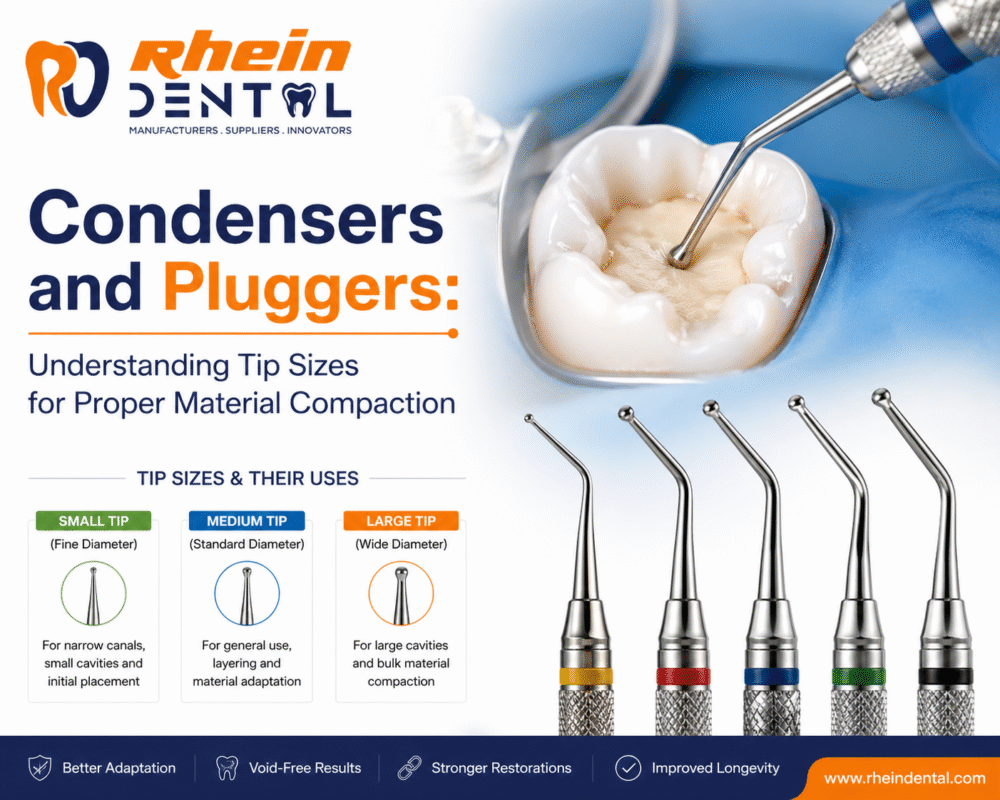
In restorative and endodontic dentistry, success depends on control—control of placement, pressure, and adaptation. Therefore, condensers and pluggers play a vital role in achieving dense, void-free restorations and well-compacted root canal fillings. Although these instruments may seem simple, their tip sizes directly influence clinical outcomes.
What Are Condensers and Pluggers?
Condensers and pluggers help clinicians compress and adapt dental materials within a cavity or root canal. While many practitioners use the terms interchangeably, each instrument serves a slightly different purpose.
- Condensers pack materials like amalgam or composite into cavity preparations.
- Pluggers, on the other hand, compact gutta-percha during root canal obturation.
In both cases, tip size determines how effectively the material adapts to the tooth structure.
Why Tip Size Matters
Tip size directly affects how well material compacts and adapts. If you choose the wrong size, you risk creating:
- Voids or gaps in the material
- Weak restorations due to poor density
- Inadequate marginal adaptation
- Microleakage and early failure
For this reason, selecting the correct tip size ensures even pressure distribution and precise material placement, especially in challenging areas.
Common Tip Sizes and Their Applications
Condensers and pluggers come in a range of tip diameters. Each size serves a distinct purpose, so understanding their roles improves efficiency and results.
1. Small Tips (Fine Diameter)
- Ideal for narrow cavities and root canals
- Additionally, they help with initial material placement
- Reach deep or confined areas with ease
- Commonly used in anterior and pediatric cases
2. Medium Tips (Standard Diameter)
- Suitable for most restorative procedures
- Moreover, they balance pressure and control effectively
- Work well for layering and adapting materials
3. Large Tips (Wide Diameter)
- Best for large posterior restorations
- As a result, they allow faster bulk compaction
- Ensure consistent density across wider surfaces
Matching Tip Size to the Clinical Situation
Choosing the right tip size requires careful evaluation. First, consider the cavity size and shape. Next, evaluate the material type and access.
- Use smaller tips for intricate or deep areas
- Switch to larger tips for broader surfaces
- Adjust based on visibility and access
- Finally, align your choice with your technique
In practice, clinicians often begin with a small tip to adapt material into corners. Then, they move to larger tips for final compaction.
Material-Specific Considerations
Different materials respond differently to pressure. Therefore, tip selection must match the material.
- Amalgam: Requires firm pressure; start small and move to larger tips
- Composite: Needs controlled pressure; avoid excessive force
- Gutta-percha: Requires pluggers that match canal size for proper obturation
If you match the tip correctly, you preserve material integrity and improve adaptation.
Design Features That Enhance Performance
Modern instruments include features that improve handling and efficiency. For example:
- Serrated or smooth tips for better control
- Color-coded sizes for quick identification
- Ergonomic handles to reduce fatigue
- High-quality stainless steel for durability
Consequently, these features support better performance when combined with the right tip size.
Best Practices for Effective Compaction
To achieve optimal results, follow a structured approach:
- Start with smaller tips and progress to larger ones
- Apply steady, controlled pressure
- Avoid excessive force that may damage the tooth
- Keep instruments clean and well-maintained
- Choose high-quality tools for consistent outcomes
By following these steps, you can significantly improve compaction quality.
Conclusion
Condensers and pluggers may appear basic; however, they have a powerful impact on restorative success. When you understand tip sizes and apply them strategically, you improve material density, marginal adaptation, and durability.
Ultimately, precision begins with the right instrument choice. By refining your approach to tip selection, you can deliver stronger, longer-lasting restorations with confidence.