

In restorative and prosthodontic dentistry, the accuracy of impressions plays a critical role in ensuring the success of final restorations. One often overlooked yet essential factor influencing impression quality is the type of tray used. Choosing between perforated and solid impression trays can significantly impact material retention, dimensional stability, and overall accuracy.
This article explores the key differences, advantages, and clinical considerations of both tray types to help dental professionals make informed decisions.
Understanding Impression Trays
Impression trays act as carriers for impression materials, holding them in place while capturing the detailed anatomy of oral structures. They are typically made from stainless steel or rigid plastic and are available in perforated and non-perforated (solid) designs.
Perforated Impression Trays
Design Features
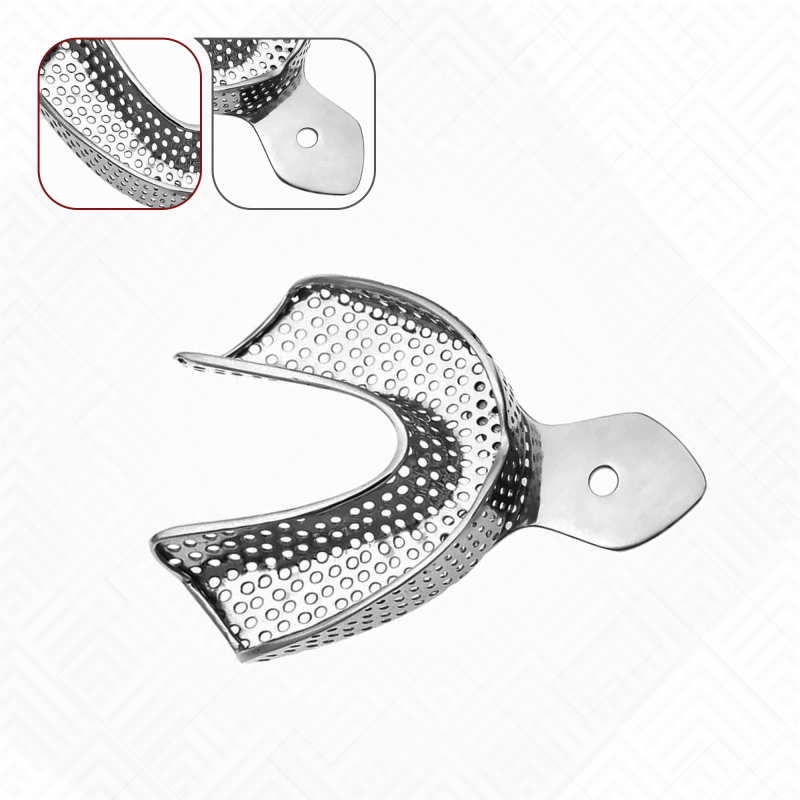
Perforated trays contain multiple small holes across their surface. These perforations allow impression material to flow through and mechanically lock into the tray.
Material Retention Mechanism
Retention is achieved through mechanical interlocking, where the material extrudes through the holes and secures itself once set.
Advantages
- Enhanced retention without adhesive in many cases
- Ideal for alginate and other hydrocolloid materials
- Reduces the risk of impression separation during removal
- Cost-effective and widely available
Limitations
- Potential for material distortion if excessive pressure is applied
- Less suitable for highly accurate elastomeric impressions
- Cleanup can be more time-consuming due to material seepage
Solid Impression Trays
Design Features
Solid trays have a smooth, non-perforated surface. They rely on adhesives rather than mechanical retention.
Material Retention Mechanism
Retention depends on chemical bonding between the tray adhesive and the impression material.
Advantages
- Provides uniform support, minimizing distortion
- Preferred for elastomeric materials (e.g., silicone, polyether)
- Allows for greater control of material thickness
- Cleaner application with less excess material
Limitations
- Requires proper application of tray adhesive
- Risk of debonding if adhesive protocol is not followed correctly
- Slightly higher technique sensitivity
Accuracy Considerations
Material Compatibility
- Perforated trays perform best with alginate, where mechanical retention is sufficient.
- Solid trays are superior for elastomeric materials, which demand high dimensional stability.
Thickness Control
Uniform thickness of impression material is essential for accuracy. Solid trays often provide better control, reducing the chances of uneven shrinkage.
Distortion Risk
- Perforated trays may introduce distortion if material flows unevenly through holes.
- Solid trays minimize this risk when adhesive is properly used.
Removal from Mouth
Secure retention (mechanical or adhesive) prevents distortion during removal. Poor retention can lead to tearing or separation, compromising the impression.
Clinical Applications
| Scenario | Recommended Tray Type |
|---|---|
| Preliminary impressions | Perforated trays |
| Diagnostic casts | Perforated trays |
| Crown & bridge work | Solid trays |
| Implant impressions | Solid trays |
| High-precision prosthetics | Solid trays |
Best Practices for Optimal Results
- Always match the tray type with the impression material
- Use tray adhesive consistently with solid trays
- Ensure proper tray size and fit to avoid distortion
- Maintain uniform material thickness
- Avoid overloading trays, especially perforated ones
Conclusion
Both perforated and solid impression trays have their place in modern dentistry. The choice ultimately depends on the clinical application, material used, and the level of accuracy required.
- Choose perforated trays for convenience and hydrocolloid impressions.
- Opt for solid trays when precision and dimensional stability are critical.
By understanding the strengths and limitations of each, dental Professionals can significantly improve impression outcomes and ultimately patient satisfaction.