
Introduction
Accurate dental impressions remain the foundation of successful restorative, prosthodontic, orthodontic, and implant treatments. While impression materials often receive the most attention, the impression tray plays an equally important role in ensuring dimensional accuracy. A tray that flexes during impression taking or removal can distort the impression, leading to inaccurate models, poorly fitting restorations, and costly remakes.
Among the most common options available today are metal and plastic impression trays. Understanding the rigidity requirements of different impression materials can help clinicians select the most suitable tray for each clinical situation.
Why Tray Rigidity Matters
An impression tray acts as the support structure for the impression material. During seating, setting, and removal, significant forces can be applied to both the tray and the material.
If the tray flexes under these forces:
- The impression may distort.
- Marginal accuracy can be compromised.
- Occlusal relationships may be altered.
- Remakes and chairside adjustments may increase.
The rigidity of the tray becomes particularly important when working with highly accurate elastomeric impression materials that are capable of reproducing fine detail.
Metal Impression Trays
Key Characteristics
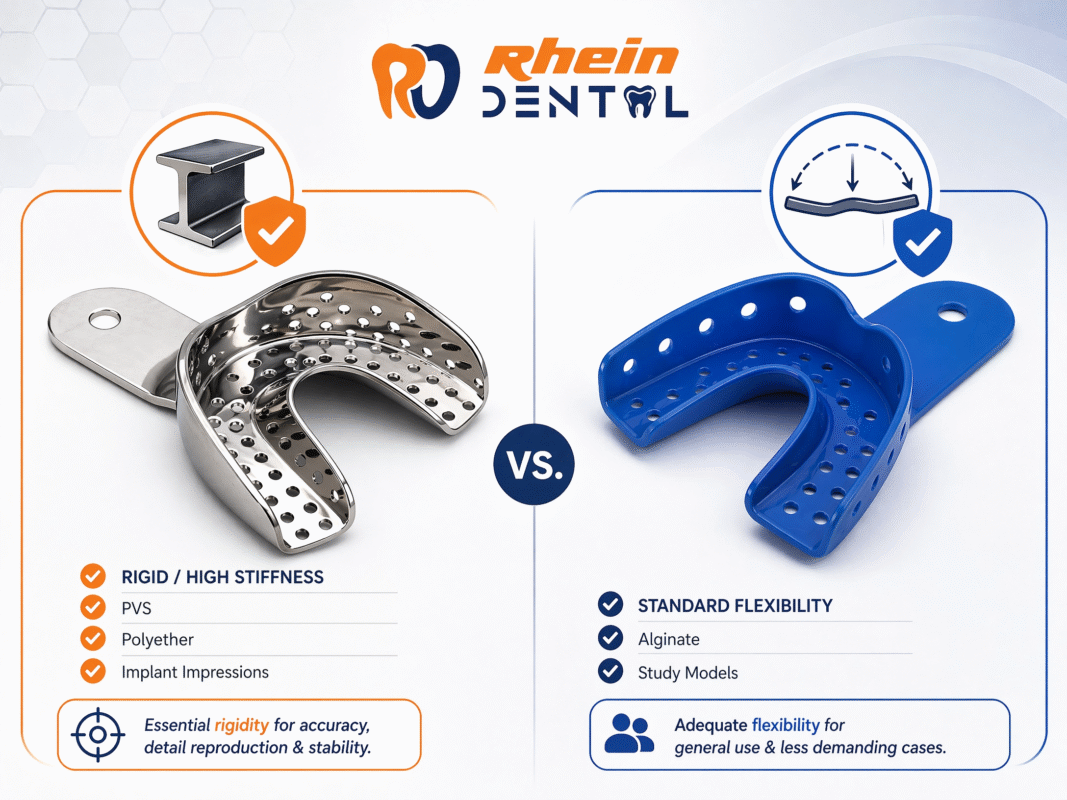
Metal impression trays are typically manufactured from stainless steel or aluminum and offer superior rigidity compared to plastic alternatives.
Advantages
- Excellent resistance to flexing.
- High dimensional stability.
- Suitable for precision impressions.
- Can withstand repeated sterilization.
- Long service life and cost-effectiveness over time.
Best Applications
Metal trays are commonly preferred for:
- Crown and bridge impressions
- Implant impressions
- Fixed prosthodontics
- Precision restorative procedures
- Full-arch elastomeric impressions
Because they resist deformation, metal trays help preserve the accuracy of materials such as polyvinyl siloxane (PVS) and polyether.
Limitations
- Higher initial investment.
- Heavier than plastic trays.
- May require tray adhesive for optimal retention.
Plastic Impression Trays
Key Characteristics
Plastic trays are typically manufactured from high-strength polymers and are available in disposable and reusable designs.
Advantages
- Lightweight and comfortable.
- Cost-effective for single-use applications.
- Reduced risk of cross-contamination.
- Convenient for high-volume practices.
Best Applications
Plastic trays are often used for:
- Preliminary impressions
- Orthodontic impressions
- Study models
- Diagnostic casts
- Situations where extreme precision is not required
Limitations
The primary concern with plastic trays is potential flexure under load. Even small amounts of tray distortion can affect the accuracy of the final impression, particularly when using rigid or highly accurate impression materials.
Impression Material and Tray Selection
Alginate Impression Materials
Alginate remains one of the most widely used materials for preliminary impressions, study models, and orthodontic records.
Tray Requirements
Because alginate is relatively flexible and generally used for diagnostic purposes, plastic trays are often acceptable.
Recommended Trays:
- Plastic perforated trays
- Metal perforated trays
- Disposable trays
While metal trays provide greater stability, many clinicians successfully use high-quality plastic trays with alginate.
Polyvinyl Siloxane (PVS) Impression Materials
PVS materials offer excellent dimensional stability, detail reproduction, and elastic recovery.
Tray Requirements
These materials demand maximum tray rigidity to prevent distortion during impression removal.
Recommended Trays:
- Rigid stainless-steel trays
- Custom metal trays
- Reinforced rigid trays
For full-arch crown and bridge impressions, metal trays are generally considered the preferred choice.
Polyether Impression Materials
Polyether materials are known for their accuracy and hydrophilic properties but tend to be relatively stiff after setting.
Tray Requirements
Because removal forces can be substantial, tray rigidity becomes even more critical.
Recommended Trays:
- Stainless-steel impression trays
- Heavy-duty rigid trays
- Custom trays for complex cases
Flexible plastic trays may distort under these conditions, affecting impression accuracy.
Zinc Oxide Eugenol (ZOE)
ZOE materials are commonly used for edentulous impressions and complete denture procedures.
Tray Requirements
Custom trays or rigid metal trays are generally recommended to maintain dimensional stability throughout the impression process.
Custom Trays vs. Stock Trays
For highly precise restorative and implant procedures, custom trays often provide superior results regardless of material type.
Benefits of Custom Trays
- Uniform material thickness
- Reduced distortion
- Better material control
- Enhanced accuracy
When maximum precision is required, a custom tray combined with an elastomeric impression material can significantly improve outcomes.
Clinical Guidelines for Tray Selection
When selecting an impression tray, clinicians should consider:
Choose Metal Trays When:
- Taking implant impressions.
- Recording crown and bridge preparations.
- Using polyether materials.
- Using high-accuracy PVS materials.
- Full-arch precision is required.
Choose Plastic Trays When:
- Taking preliminary impressions.
- Creating diagnostic models.
- Recording orthodontic impressions.
- Using alginate for non-critical procedures.
- Single-use convenience is preferred.
Cost Considerations
Although metal trays have a higher upfront cost, their durability often makes them more economical over time. Reusable stainless-steel trays can withstand hundreds of sterilization cycles, reducing replacement expenses.
Plastic trays offer lower initial costs and convenience but may require more frequent replacement and may not provide the rigidity needed for advanced restorative procedures.
Conclusion
The choice between metal and plastic impression trays should be guided by the accuracy requirements of the procedure and the properties of the impression material being used. While plastic trays perform adequately for many preliminary and diagnostic applications, metal trays remain the gold standard for procedures where dimensional accuracy is critical.
For crown and bridge work, implant cases, and impressions using PVS or polyether materials, the superior rigidity of metal trays helps minimize distortion and supports predictable clinical outcomes. By matching tray rigidity to the demands of the impression material, dental professionals can improve impression accuracy, reduce remakes, and deliver better patient results.